
Like an Electric Shock
The Napoleonic Wars: Trafalgar, 1805

You can find the previous part of the Napoleonic Wars series here.
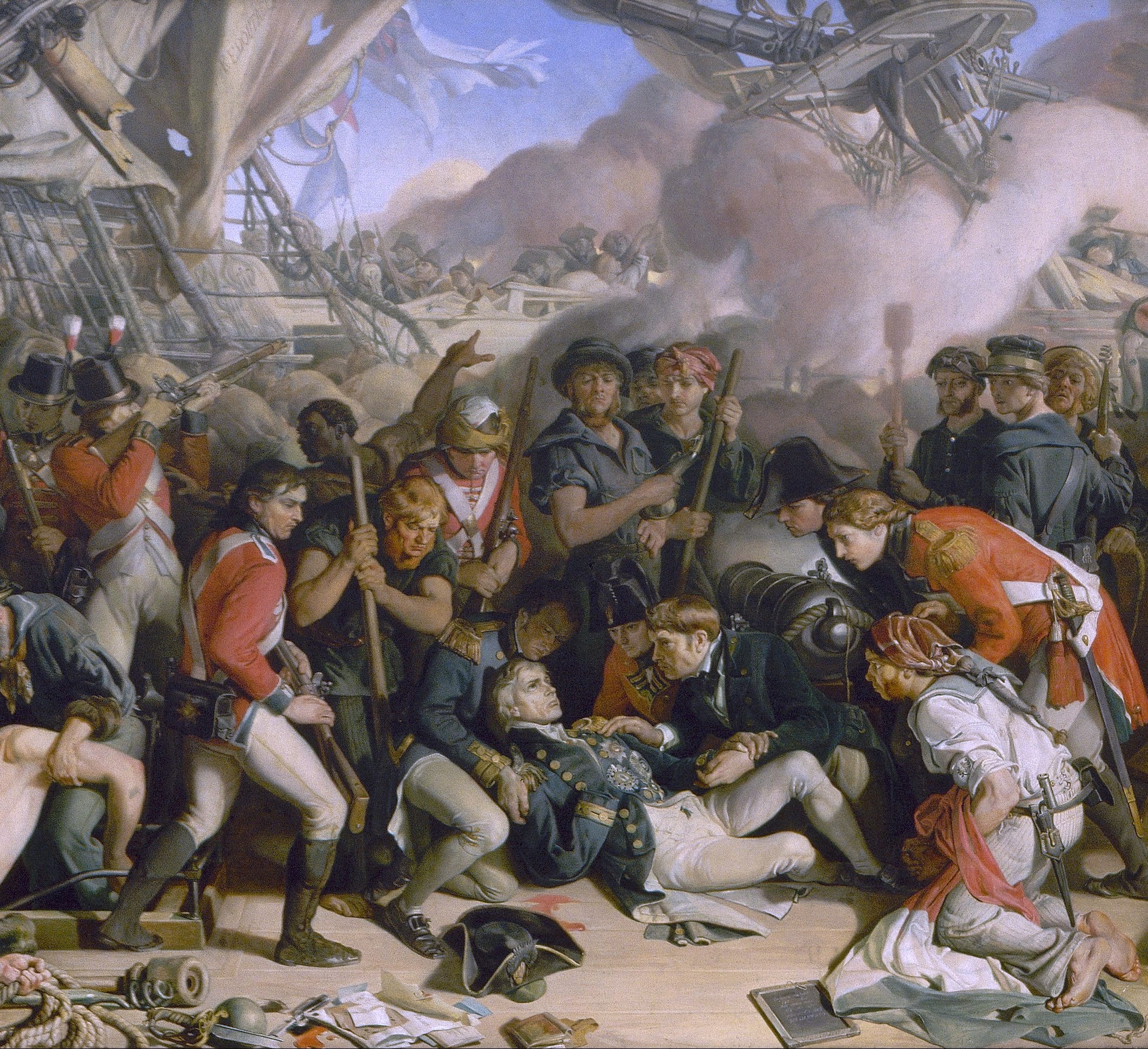
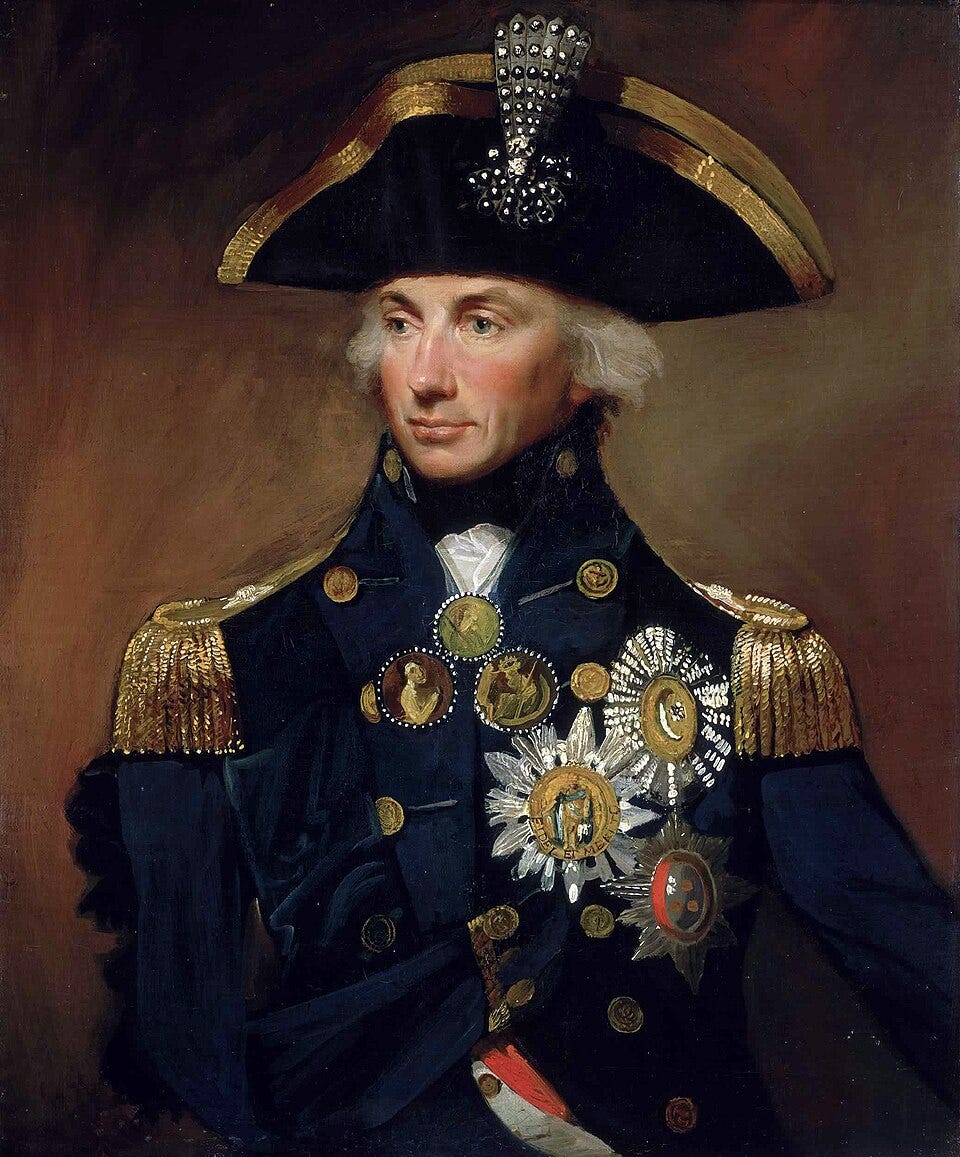
“When I came to explain to them [the captains of the fleet] the ‘Nelson touch,’” Vice Admiral Horatio Nelson wrote to his mistress, Lady Hamilton, “it was like an electric shock.” Nelson was nothing if not proud, yet also talented enough to justify such pride. “Some shed tears, all approved—it was new—it was singular—it was simple!” No doubt something of an exaggeration. But his character was known to have an effect of profuse admiration among those who served under him.
And just what was this “Nelson touch?” A month earlier, to his friend, Captain Richard Keats, Nelson provided insight.
I shall form the fleet into three divisions in three lines. One division will be composed of twelve or fourteen of the fastest two-decked ships, which I shall keep always to windward [upwind] […] with the remaining part of the fleet formed in two lines, I shall go at them at once […] I think it will surprise and confound the enemy. They won’t know what I am about. It will bring on a pell-mell battle, and that is what I want.
But more than that—some have incorrectly ascribed the creation of that strategy to Nelson, though similar plans had already been done by others with notable success—the “Nelson touch” was his emphasis on the initiative of his captains. This tendency sprung from his innate trust in them and in his unshakable faith in both the qualities of the British sailor and the strength and power of the ships of the fleet. From this trust, and his own bottomless well of natural charisma, charm, and social graces, sprung genuine devotion from nearly all of the men and officers who served under him. And by 1805, he had established a record worthy of reverence.
The same day Nelson spoke with the captains in his fleet—October 9, 1805—he wrote a memorandum which reflected, among many other things, his signature plucky spirit, total self-assuredness, and unflappability:
Something must be left to chance, nothing is sure in a sea fight beyond all others, shot will carry away the masts and yards of friends as well as foes, but I look with confidence to a victory before the Van[guard] of the Enemy could succour their Rear […] should the Enemy close [the distance to fight] I have no fear as to the result. […] in case Signals can neither be seen or perfectly understood[,] no Captain can do very wrong if he places his Ship alongside that of an Enemy.
The greatest battle of the Age of Sail, and one of the most influential in naval history, was about to take place. Outnumbered and outgunned, Nelson was going to gamely advance to attack the enemy fleet, seeking to destroy it utterly with a tactic that was extremely risky but offered the potential for significant success.
Thus Horatio Nelson, perhaps the most astonishing character in all the Age of Sail— and the man who, on three occasions, completely dashed Napoleon’s hopes for long-term strategic dominance and success.
Not one, but two, great world-changing battles were fought in 1805. One battle cemented the reputation of its victor as one of the greatest commanders in history: fighting against the odds, far from home, against an equally deadly and more numerous enemy. The other battle was all of these things, too; but its legacy was far greater. The consequences of the first battle, Austerlitz, spectacular though it was, were completely undone in less than a decade.
The second battle, Trafalgar, cemented for thirteen decades the total global supremacy of the Royal Navy, and Britain’s status as the greatest naval power in history to that point. Trafalgar and its victor, Horatio Nelson, guaranteed the Pax Britannica of the 19th century and the British colonial empire’s status as history’s largest. Nelson, of course, would live to see none of it, but he died knowing, as he himself said in his last moments, that he had “done [his] duty.”
Naval Warfare in the Late Age of Sail
In the Age of Sail, as can be deduced, the ability for ships not only to fight, but even simply to move, was determined by the weather.
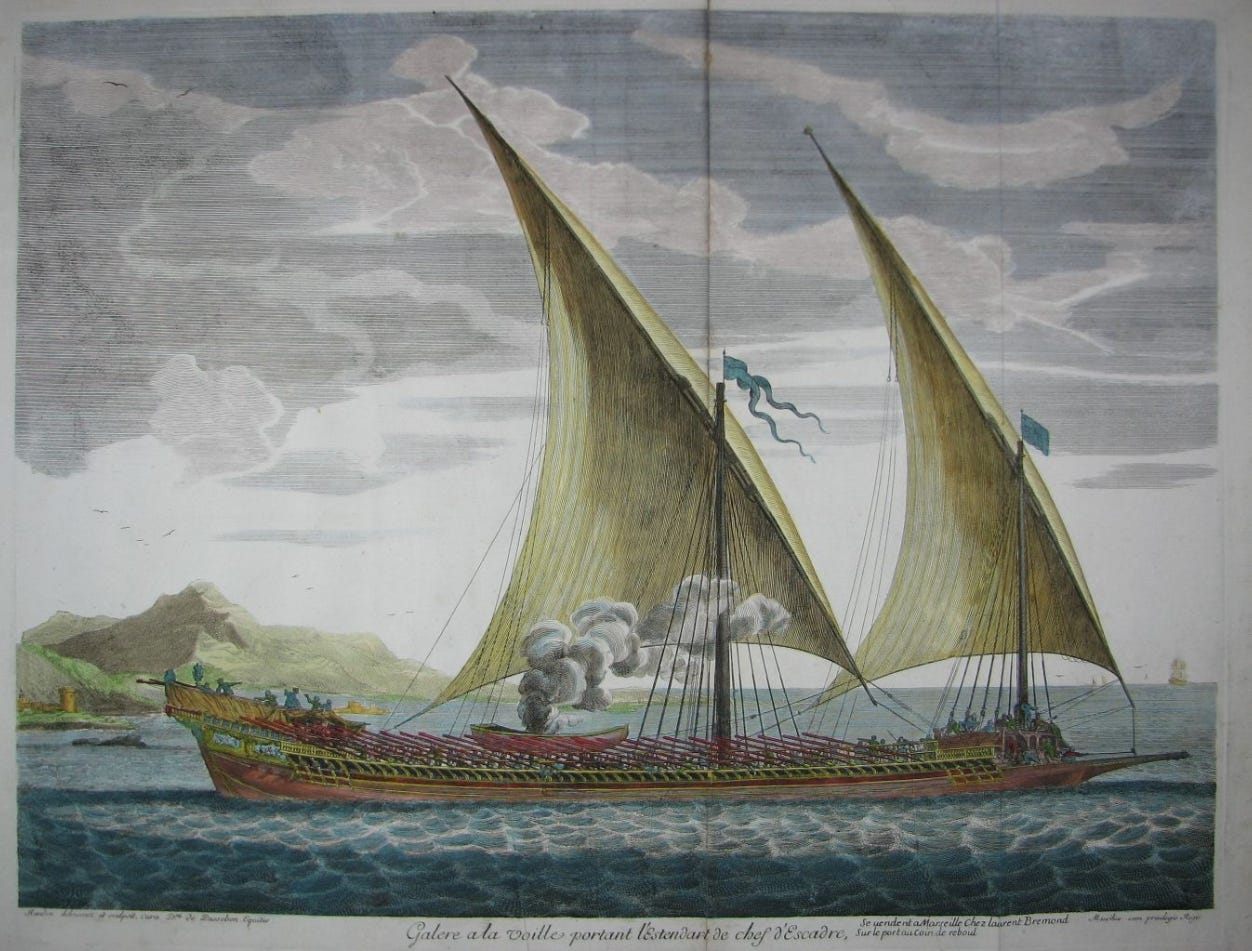
Prior to the Age of Sail, many ships in the Old World used dozens of oars to propel them through the water. These oars permitted movement on the seas without requiring favorable winds. Adversely, entire decks would have to be set aside to use them, and their employment required a significant dedication of manpower, taking away from the number of men who could fight with ranged weapons. It was also a fatiguing task which could exhaust a crew before it even engaged the enemy. Oars were a supplementary, but sometimes primary, method of ship propulsion for thousands of years, from the dawn of history through to the Age of Exploration. The preponderance of oars as a method of propulsion was more common on warships than on commercial or private vessels.
Oars began to fall out of fashion in the 16th century. The advent and proliferation of naval cannons, the increase in size of naval vessels of all kinds, and the growth of maritime commerce—space taken up by oarsmen could otherwise be used to increase cargo capacity—meant that the utility and efficacy of oars decreased, and eventually they fell by the wayside. Not all navies abandoned oar-powered ships—the beyliks of the North African corsair slaver kingdoms continued to use oared xebecs, galleys, and galleasses into the early 19th century, helping them to catch and board victims who could not escape by wind power alone. Even some European Mediterranean powers utilized oar-powered ships, to varying degrees, well into the Age of Enlightenment. But the overwhelming preponderance of naval vessels of the 17th, 18th, and early 19th centuries relied solely on the power—and oftentimes suffered at the mercy—of the wind.
Sailing warships
Warships in the late Age of Sail were powered by between one and three masts. Frigates and ships of the line, the primary naval vessels of the period, all had three (the foremast at the bow, or front, of the ship; the mainmast amidships; and the mizzenmast astern, or rearward). The bowsprit, jutting off the bow of the vessel, provided additional space for sails and helped to further strengthen and stabilize the foremast by use of additional rigging. Warships mounted their guns on both sides of the ship,1 usually dividing their firepower equally between each so-called “broadside.” One or two guns were also sometimes mounted fore and aft, to fire at ships ahead or astern. These were known as “chasers,” and their employ was almost always limited to frigates and other small vessels which had the speed required to chase down other ships, like merchantmen. The famous frigate USS Constitution, for example, was designed to mount 44 guns: 21 on each broadside, plus two bow chasers.2
There were many other kinds of sailing vessels—ketches, schooners, brigs, sloops, barques—many of which had military applications, and were either refitted or built from the ground up for naval service. The primary warships of the age, however, were the frigate and the ship of the line.
The frigate, as is generally understood, materialized in the mid-17th century as a single-decked vessel mounting at least 20 and sometimes up to 32 guns. Their narrower hulls and smaller tonnage permitted higher speeds—in good weather, in excess of 10 knots (10 nautical miles per hour). Frigates usually mounted 12-pounder guns,3 more powerful than the light 6- and 9-pounders of smaller sloops and brigs. Their speed and size made them ideal “cruisers,” prowling the ocean to hunt enemy commercial shipping. When attached to the fleet, frigates also served as scouts and emergency packet ships, delivering messages over long distances. In the aftermath of a decisive naval action, they could hunt down and finish off wounded ships. They also provided escort to important merchant vessels and even larger convoys of multiple vessels.
In the second half of the 18th century, frigates began to grow in size and strength. The gun deck (below the “weather,” or top, deck) increasingly became home to additional cannon; the number of guns increased; the caliber of guns increased to 18- and then even 24-pounder long guns.4 By the height of the Napoleonic Wars, major navies were building and commissioning frigates designed to mount 44 guns on two decks, and capable of reaching 14 knots in favorable winds. These ships carried cannon equivalent to the heaviest found on 64-gun ships of the line, plus heavy short-barreled 68-pounder guns, called caronnades, designed to deliver devastating blows at close range. (The British traditionally did not count caronnades toward a ship’s gun complement, though historians have tended to do so.)
Ships of the line—from which the term “battleship” originates, as in “line of battle ship”—were the primary capital ships of any navy. The largest vessels mounted over 100 guns, up to a third of which could be the heaviest 32, 36- and 42-pounder long guns, traditionally the largest cannons afloat. The further the gun deck from the waterline, the lighter the cannons became, so as to ensure the ship’s center of gravity was as low as possible to preserve seaworthiness. Ships of the line could be over 200 feet long including the bowsprit, and about as high from the waterline to the top of the mainmast.
In major fleet actions, it was the ships of the line that fought one another. Frigates would remain at a distance and usually not become engaged unless the enemy was already crippled. To become embroiled in a battle as a frigate captain was considered a breach of honor. But more importantly, frigates were terribly vulnerable to the powerful broadsides of these heavy warships.
The largest ships of the line could carry crews of over 800 men and displace thousands of tons. (The Spanish Santísima Trinidad, the largest warship of the age, displaced 5000 tons and was crewed by over 1000 men.) Knowing a ship’s gun count could offer a rough approximation of the ship’s strength, though it did not scale linearly. This was further complicated at the turn of the century, as more and more frigates began to also mount caronnades to increase their ability to punch above their weight. For example, the gun deck of Constitution and her sisters mounted 24-pounders; on their upper decks they carried between 20 and 28 caronnades firing between 32 and 42-pound shot, giving them a devastating close-range broadside.
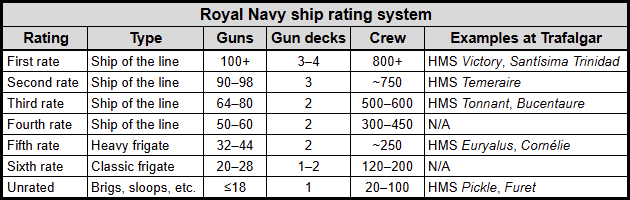
In the early 18th century, the Royal Navy sought to implement a degree of standardization to ease construction and maintenance of its vast fleet in its various shipyards. It adopted a system, modified slightly over the decades, to classify ships by the number of guns they carried. This so-called “rating system” used six tiers, from first through sixth rate, from most to least guns. Most frigates were sixth rates. Some, especially the “heavy frigates” of the late 18th and early 19th centuries, were fifth rates. Fourth rates and above were considered true ships of the line. Other navies generally followed Britain’s suit, adopting their own rating systems which mirrored and drew broad similarities with the British model.
The most common ships of the line were generally those classed as third rates, often with 64, 74, or 80 guns, and they served as the standard capital ships of the day and were the workhorses of any navy. First rates, because of their strength, were, when available, typically taken by admirals as fleet flagships. Second rates became less popular in the latter half of the 18th century, as their large gun count relative to their size tended to make them less seaworthy and more difficult to handle. By the Napoleonic era, even fourth rates were often no longer considered sufficient to man the battle line, and were quietly phased out of service in most navies.
Tactics and combat
Naval artillery could generally have a maximum range of up to 3000 yards, which was far beyond the maximum range of most land artillery. In battle conditions, however, this distance was unrealistic if one expected any degree of accuracy. Additionally, the penetration power of shot fell off significantly, especially in lighter guns, at greater distances. Sailors and captains considered the optimal distance for engaging an enemy to be about 400 yards or less, in order to maximize hit probability.
To fire “at point blank range” came from the mathematics of gunnery, where “point blank primitive” was the distance at which a fired shot would, by gravitational forces, be pulled below the cannon’s line of sight. Beyond that distance, the gun would have to be elevated from a horizontal position in order to hit the intended target, a process which, while quick enough, could become tedious and even troublesome under battle conditions. Therefore, this more or less maximum optimal engagement distance—around 400 yards for most cannon—became “point blank range,” which in common parlance came to mean, by semantic shift, “as close as possible.” Oftentimes, however, fleets and individual captains would prefer to engage the enemy at even closer distances—200 or 100 yards, or even less. The effect on morale of a broadside at these distances cannot be understated, and the destruction wrought would be far greater.
These guns (referred to in the Royal Navy as “great guns” to distinguish from muskets and pistols) fired three types of ammunition: the simple, multipurpose, spherical round shot (from which the phrase “rounds of ammunition” is derived), or traditional cannonball, which made up about 80 percent of ammunition aboard ships; “dismantling shot,” comprising two cannonballs connected by a short sturdy chain (chain shot) or long metal bar (bar shot), both ideal for shooting away rigging and damaging sails and masts if the guns were elevated; and anti-personnel shot, which included canister- (used almost exclusively in the army) and grape shot, which, mimicking a shotgun, comprised very large musketballs (about 2 inches in diameter) held together in a canvas bag (which resembled a cluster of grapes). Mortars and howitzers, firing their explosive shells in an arc, were also sometimes occasionally used. Many Spanish ships employed some howitzers on their decks. The British, on the other hand, tended to relegate their mortars to specialized ships which did not play a role in the traditional battle between two fleets.
Major fleet actions began to involve the use of the “line of battle” in the 16th and 17th centuries. A fleet’s heavy ships sailing in a single unbroken line offered several advantages: it essentially erased the odds of friendly fire, thereby improving accuracy confidence, and therefore rate of fire; and additionally improved command and control, which, in the days before radio, was even worse at sea than on land. Should a fleet commander choose to disengage, a single flag or series of flags had to be raised on the fleet flagship, and then acknowledged by the leading ship. In a chaotic melee, on the other hand, the battle would often persist until one side had been utterly defeated. The late historian Brian Tunstall put it well: “Success in war depended on an admiral’s ability to organize a body of ships into a disciplined fleet, capable of obeying his instructions and signals.” This was harder than it sounded.
An admiral’s ability to organize his fleet and exercise that command and control was best—and really only—effected by the use of signal flags. Sometimes several or all masts, plus yardarms (horizontal beams from which the sails themselves hang) could be used if visibility was poor, or if multiple orders were being issued simultaneously. Signal flags had simple and easily identifiable signs, using just a few colors: blue, red, and yellow (plus the white/buff of unpainted linen); horizontal and vertical stripes; crosses; checkers; pendants; centered circles and squares; and colored borders, among many other designs.
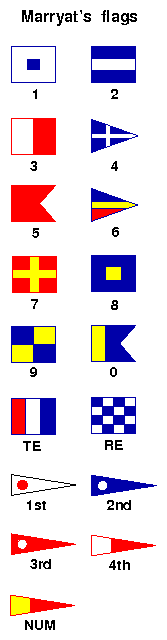
Admirals were also sometimes known to issue full sets of signal flags to one or several frigates attached to the fleet. When battle was joined, frigates, sailing further away on the unengaged side of the fleet, would read an admiral’s changing orders over the course of the battle, then hoist the same orders on their own masts, so that all captains could understand the admiral’s signals if visibility on the battle line was worsened by cannon smoke. Signals were predetermined by the use of signal books, issued by the admiralty, to standardize signaling across the whole navy. A single flag could mean a number, letter, word, or even parts of or entire phrases. Admirals could also issue predetermined special signals which were not otherwise available in the signal books. (At the Battle of Tsushima in 1905, Japanese Admiral Togo famously used the letter Z, hoisted alone, to mean, “The fate of the Empire rests on the outcome of this battle. Let every man do his utmost.”)
In the Royal Navy, captains could simply raised the signal for “acknowledge” to let an admiral know the order was received. In the French navy, signals would have to be repeated in full, the idea being admirals wanted to ensure their orders were not misinterpreted. To best ensure an admiral’s intent was understood, however, councils of war were often called on the eve of battle on the fleet flagship. Even if signals were unreadable at the height of battle, the admiral’s general intent would be known. To maximize the likelihood that orders could be interpreted in battle, fleet commanders typically positioned their flagships in the middle of the line of battle. Captains (and squadron commanders) both at the front and rear of the line could receive and acknowledge orders quicker in this way.
The fate of a ship and its crew, and indeed even an entire fleet, could be determined by the wind. Contrary to popular belief, it was not advantageous to sail in the same direction as the wind (“running before the wind”): the rearmost sail would block or “blanket” the sails in front of them. It was instead best, if one wished to maximize speed, to “quarter,” with the wind at one’s four or seven o’clock, to allow most of the surface area of the ship’s sails to catch the wind. Sailing “close hauled,” with the wind at approximately one’s 10 or 2 o’clock, was generally possible, but could cause complications if a change of direction was required on short notice. It also, of course, drastically reduced a ship’s speed.
By its very nature, in the relation between two ships or groups of ships, one is “windward” (upwind) and one is “leeward” (downwind). In Age of Sail warfare, the windward ship was in an advantageous position: they generally could dictate the terms of the engagement, that is how and where and when to engage the enemy. Those leeward could sometimes be at their mercy. Being windward was known as “having the weather gage” (or gauge). It played a crucial role in how and when naval battles would be fought. Fleets would struggle for hours or days to win the weather gage before battle was even joined, and it nevertheless could sometimes change over the course of a fight.
Like in Antiquity when great armies could spend days jockeying for superior positioning and favorable weather on a field before finally committing to battle, fleets in the Age of Sail could spend several days on end attempting to engage one another. Not just the weather gage caused these delays, but also sometimes inclement weather, or disruptions to a fleet’s organization (themselves caused by storms or changing winds). Sometimes one fleet, being harassed and victimized, altogether rejected the possibility of battle, and would attempt to escape. Chases between two fleets on the open ocean could last for days on end.
These days-long maneuvers occurred, notably, at Minorca (1756)—where British Admiral Byng was famously put on trial and executed for failing to “do his utmost” to prevent a French invasion of the island—Ushant (1778), wherein the British and French fleets conducted a four-day pre-battle dance; and the Glorious First of June (1794), the culmination of a week-long chase between Richard Howe (brother of American Revolution general William Howe) and Louis Thomas Villaret.
Once both sides committed to battle, the engagement could still be achingly slow to unfold. By forming in line of battle and carefully maintaining the spacing between ships (usually kept at one cable length, equivalent to one-tenth of a nautical mile or approximately 200 yards), ships were held to a small percentage of their theoretical top speeds; even a relatively small fleet assembled thusly could span miles from van to rear. Tunstall again:
Even with a stiff breeze in their favor, [ships in the battle line] might well be advancing at only about four knots. It is difficult for modern readers to visualize the agonizing slowness of most sea battles under sail. Hours and even days might be spent in trying to get into the desired order of battle before launching the attack. It is easy to see that under these circumstances the strain on the admiral was terrific and why it was that both Rodney and Howe were incapable of pursuit after their respective victories of the Saintes (1782) and the First of June (1794).
A fleet of ships of the line sailing in line of battle (the formation being known as “line ahead”) thus had its benefits and its drawbacks. Command and control, while not ensured,5 was improved, and the odds of fatal miscommunication was reduced. Admirals could generally disengage at will if they found the battle not developing in their favor. But these battles were also slow, and maneuvering cumbersome. Partly due to the aforementioned ability to disengage, they tended not to be terribly decisive. Many battles ended with no ships lost on either side; in the most decisive fleet engagements, the defeated admiral would lose a handful of his heavy ships. This could be grounds for court martial, cashiering from service, imprisonment, or even, as in Byng’s extreme case, execution. But they were usually not strategically crushing failures that would alter the outcome of a war, and the defeated fleet, in any case, could live to see another day.
And therein lay the problem. By the end of the 18th century, more enterprising admirals were seeking better methods to force a decisive outcome to a fleet battle. In 1805, at least for a time, the survival of Britain as a sovereign power apparently relied on it.
Breaking the line
One of the most tactically devastating maneuvers in the Age of Sail was raking. By firing a broadside perpendicular to the enemy—that is, through the stem or stern of the opponent—one could severely damage an enemy ship and its crew, while not subjecting oneself to return fire. Raking from the rear, where a ship was weakest (there was minimal, if any, strong planking, and plenty of windows to be smashed) would cause maximal damage, with shot careening along the length of the vessel, dismembering and otherwise killing dozens or hundreds of crew and sending large wooden splinters everywhere. Raking from afore could also prove damaging, but angled planking at the bow could offer protection by deflecting some shot.
Related to the concept of raking was “crossing the T,” wherein one fleet sailed perpendicularly to its opponent, allowing its full broadsides to be fired against a more or less defenseless enemy. As ships of the line generally did not mount bow chasers, they would be unable to return fire in any meaningful way. From the late 19th century onward, crossing the T was an excellent naval tactic. In the Age of Sail, it was theoretically perfect: a fleet having its T crossed would be subjected to enemy fire for an extended period because of the slowness of their formation, during which time its sails and masts could be punctured and wrecked. But as noted by Adkin, “in practice, particularly in the days of sail and shorter-range guns, it was not necessarily so advantageous.” Furthermore, heavy guns could not be aimed left or right beyond about 20 or 25 degrees, meaning only a handful of ships in the fleet doing the “crossing” could actually fire on their victims.
Thus, as admirals groped for methods to force a decisive outcome to fleet engagements, they came upon once which showed great promise: breaking the line. As has already been stated, an admiral’s ability to command and win a fleet engagement in the Age of Sail relied on his ability to effectively communicate to his ships and exercise his authority over their movements. If this ability could be disrupted, his fleet would be at a potentially decisive disadvantage. It would turn a battle between ships in line formation into a disorganized melee; what Nelson and his contemporaries called a “pell-mell battle.” If one could maneuver his ship into the enemy line, he could rake both ships on port and starboard at very close range, while the enemy would be unable to return fire. Multiple ships could gang up on one victim, rather than the typical line tactic of each ship being assigned an “opponent” with whom they would trade broadsides until one got the better of the other.6
The tactic was of course risky. By breaking an enemy line, one necessarily broke his own. It was an aggressive course of action that would require great confidence in a fleet’s ability to handle both their ships and their guns with skill and determination. Once a fleet was committed to breaking the enemy’s line, it could not be undone. It was a big gamble, but it had to be a calculated one. In every fleet action in the final decades of the Age of Sail where a fleet’s line was broken, the perpetrator was the Royal Navy; the victim was France and her allies. Each proved decisive in favor of the former.
The tactic was Britain’s own attempt at force concentration, a strategy Napoleon had used to perfection on the Continent, but executed in the arena in which Britain, not France, had indisputable superiority: the sea. With each iteration, the British came closer to perfecting the tactic, until, in 1805, perfection was finally achieved.
The Battle of the Saintes, April 12, 1782
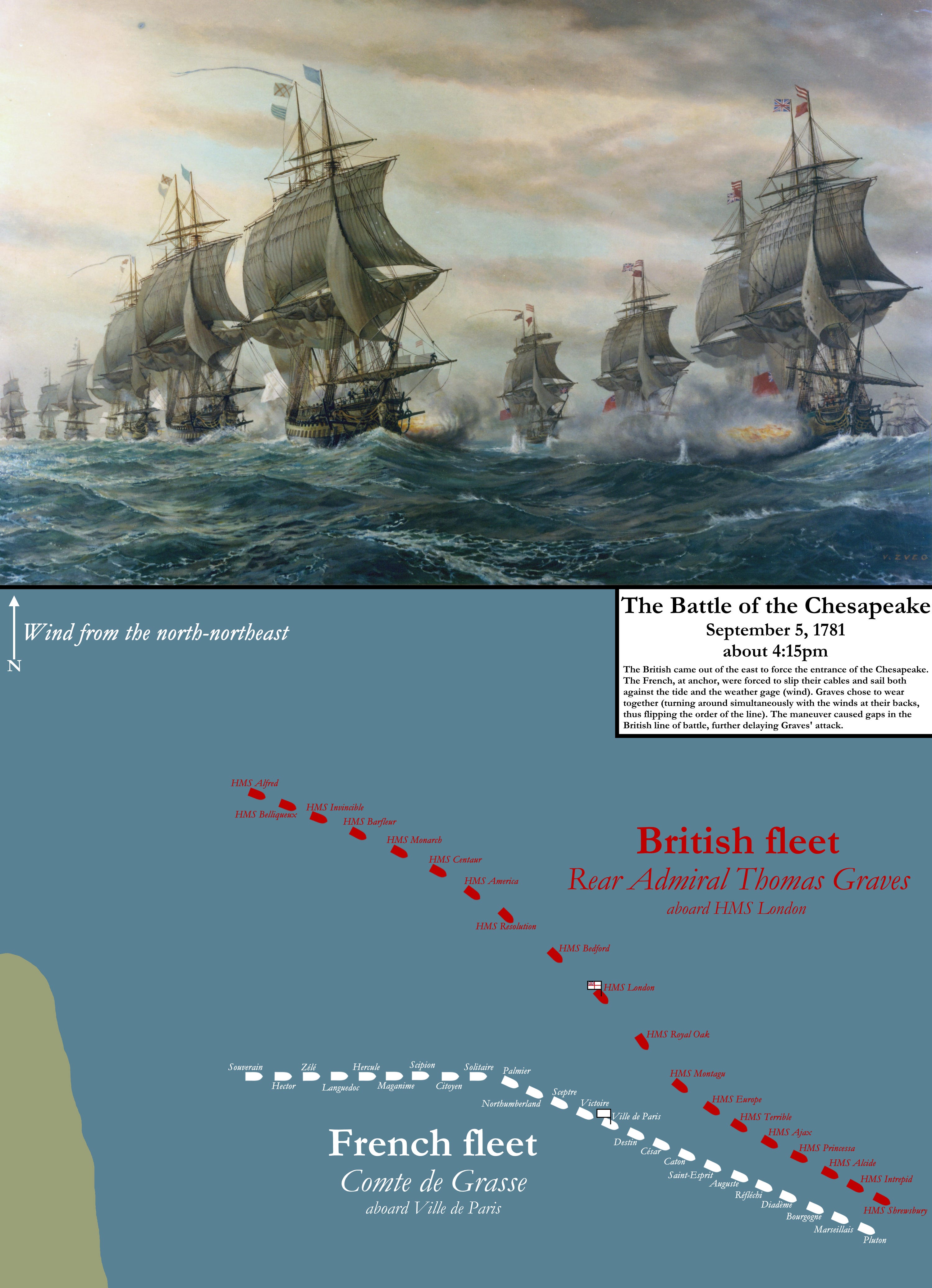
At the Battle of the Saintes in 1782, de Grasse’s fleet, fresh off their tactically indecisive but strategically significant success in the Chesapeake, was escorting a French and Spanish invasion convoy bound for Jamaica, which was key to Britain’s transatlantic sugar trade. De Grasse was intercepted by a British fleet under the command of Admiral George Rodney in the waters between Dominica and Guadeloupe. After several days of maneuvering, the fleets passed one another on opposite tacks: the British headed northward, the French southward, with the wind out of the southeast. This interestingly meant that the French, while forced to sail close-hauled (nearly into the wind), maintained the weather gage. Rodney’s ships exchanged fire with the French as they passed, then the admiral signaled for the fleet to turn to starboard and prepare for “close action.”
A gap had opened in the French line, and, with the winds shifting further south, de Grasse attempted to order his fleet to turn together to starboard (that is, from southwest to north) in order to avoid being “locked in irons.”7 Rodney’s flagship, HMS Formidable, led the British center squadron through one of the gaps in a northeasterly direction, raking the rear and center of the French line. (Rear Admiral Hood, commanding the British rear squadron, also broke the French line at a point between de Grasse’s center and van squadrons.) Rodney attempted to have his fleet tack to starboard to engage the French again, but the wind began to die off. The British were too damaged to mount a pursuit of the rest of the fleet, but it was nevertheless a significant victory. Four French ships, including the fleet flagship and de Grasse onboard her, were captured. (Twenty-five French ships of the line escaped.)
There has been debate over whether Rodney intended on breaking de Grasse’s line at any point prior to the crucial moment. Certainly he did not plan it before the battle began, but he probably intended it once he perceived that the French line was disrupted from the changing winds. The second example of a broken line was indisputably intentional, however, and held the promise of being far more spectacular.
The Glorious First of June, 1794
France was on the precipice of starvation in early 1794. Rear Admiral Louis Thomas Villaret was tasked with escorting a large grain convoy from neutral America, and for this mission he assembled a fleet of almost 40 ships of the line. After earlier naval defeats and the Siege of Toulon, where much of the French Mediterranean Fleet was devastated by scuttling, Villaret was in command of almost every heavy ship remaining in French service. The French navy had been further devastated by the Terror, with most of her experienced admirals and senior officers executed or forced into exile due to noble heritage or connections, suspected or otherwise, to Bourbon loyalist circles. (The comte d’Estaing, who served in the American Revolution alongside the late de Grasse and was perhaps France’s most experienced admiral, was put to the guillotine in April of that year.) The enlisted rates lacked experience because the Republican fleet rarely put to sea, a fact that Napoleon would fatally overlook 11 years hence. Admiral Richard Howe’s fleet, meanwhile, counting about as many ships as Villaret’s, benefitted from two straight years of high-alert service, and its crews were well-drilled and experienced.
Both fleets conducted a multi-day dance fighting for position. On May 29, Howe came to grips with Villaret’s fleet for the first time, about 400 miles west of Brittany. The wind was southerly, the French sailing west-southwest, the British parallel but slightly behind on the French starboard quarter. Howe ordered to tack southeasterly and break the French line at the rear of the column to win the weather gage and separate Villaret’s rearmost ships from the rest of the fleet. The British attack was disjointed and only some ships participated; it did not prove decisive, as the French rear squadron, battered though it was, slipped away. But Howe was set on repeating the affair. On the 30th and 31st there was dense fog that precluded battle, but June 1 proved promising.
After five hours of maneuvering before and after dawn, Howe brought his fleet into action. At 7:30am, he ordered for the fleet to pass through the enemy line, and an hour later for each ship to “steer for and engage her opponent.” The two orders, seemingly at odds, caused confusion among his captains. Villaret was moving west with a south-southwesterly wind. Howe closed the distance rapidly with the fleet sailing northwest in an oblique line abreast formation (each ship next to the other), but while his flagship, the 100-gun HMS Queen Charlotte, and five other ships successfully broke the French line and began raking ships port and starboard alike, the rest of the British fleet turned to port (westward) and began trading broadsides with their opponents. From 9:30am until the fighting’s conclusion at about 1pm, the fleets were locked in intense battle. Fire slackened after noon and the battle essentially came to a close. Villaret, for his part, performed well under the circumstances, and additionally he had achieved the objective given to him by the government. The grain convoy got through to France, and he avoided a shattering defeat. But his fleet was still badly beaten: nine ships had been completely dismasted, and six total were captured. In absolute terms, it was Britain’s greatest naval victory over France since Quiberon Bay in 1759.
Tunstall attributes Howe’s victory to two factors: first, his own ingenuity and aggression; and second, the superior training and experience of British crews, and particularly his gun crews. Of course, the French fought their ships well and with particular bravery. The disparity in fleet experience has sometimes been exaggerated to suggest that, in all of the Revolutionary and Napoleonic wars, French crews were poor, which, at least prior to 1805, was not the case. But either way, the latter of the two factors would become a throughline in the final major naval battles of the conflict.
The Battle of Camperdown, October 11, 1797
No other battle prior to Trafalgar better typified the tactic of breaking the enemy line than at Camperdown. It is probably more to Camperdown than to any other battle—it is most often claimed that Howe’s victory was the bigger contributor—that inspiration to Nelson can be ascribed. It was also the last battle in a 150 year-long naval rivalry between the English (then British) and Dutch, and its result heralded the indisputable end of the Netherlands’ status as a global naval power.
Both fleets were approximately equal in strength and numbers: Admiral Adam Duncan had sixteen ships of the line to Vice Admiral Jan Willem de Winter’s fifteen, which were augmented by several heavy frigates with 32, 36, and 44 guns. Neither fleet possessed anything heavier than a third-rate (74 guns). The Dutch were on a northeasterly course on a wind out of the north-northwest, sailing within sight of the Dutch shore. Duncan sought to break Winter’s line from the northwest and position himself between the Dutch fleet and their refuge ashore, several miles distant. To this end he divided his fleet into two divisions of eight ships each, with himself commanding the windward division in the north. His plan was to get at the van and rear of the Dutch line, separating them from the center, and annihilating them both before the latter could come to the aid of either squadron.
The approach was painfully slow, with the British fleet moving at perhaps three knots for over three hours, until battle was joined shortly before 1pm. Duncan’s fleet successfully broke Winter’s line at two points, with most of his vessels raking ships with each broadside and then engaging in a chaotic “pell-mell” fight at close range. As hoped, the Dutch center, isolated and not under attack, could not come to the aid of either the van or rear of the column until it was too late. Their absence was certainly felt, with the British achieving numerical superiority at both ends of the battlefield. It was all over in just two hours. Winter and his flagship Vrijheid (“Freedom”), along with eight other ships of the line and two frigates, were captured. Duncan’s losses were about 800 men killed and wounded, with multiple ships heavily damaged but none lost. (Vrijheid was captured by William Bligh, captain during the infamous mutiny on the Bounty in 1789.)
Of all the numerous open-ocean fleet battles of the 18th and 19th centuries, Camperdown, by percentage of ships captured,8 was the most complete victory won by any navy. Royal Navy officers all over the world took note.
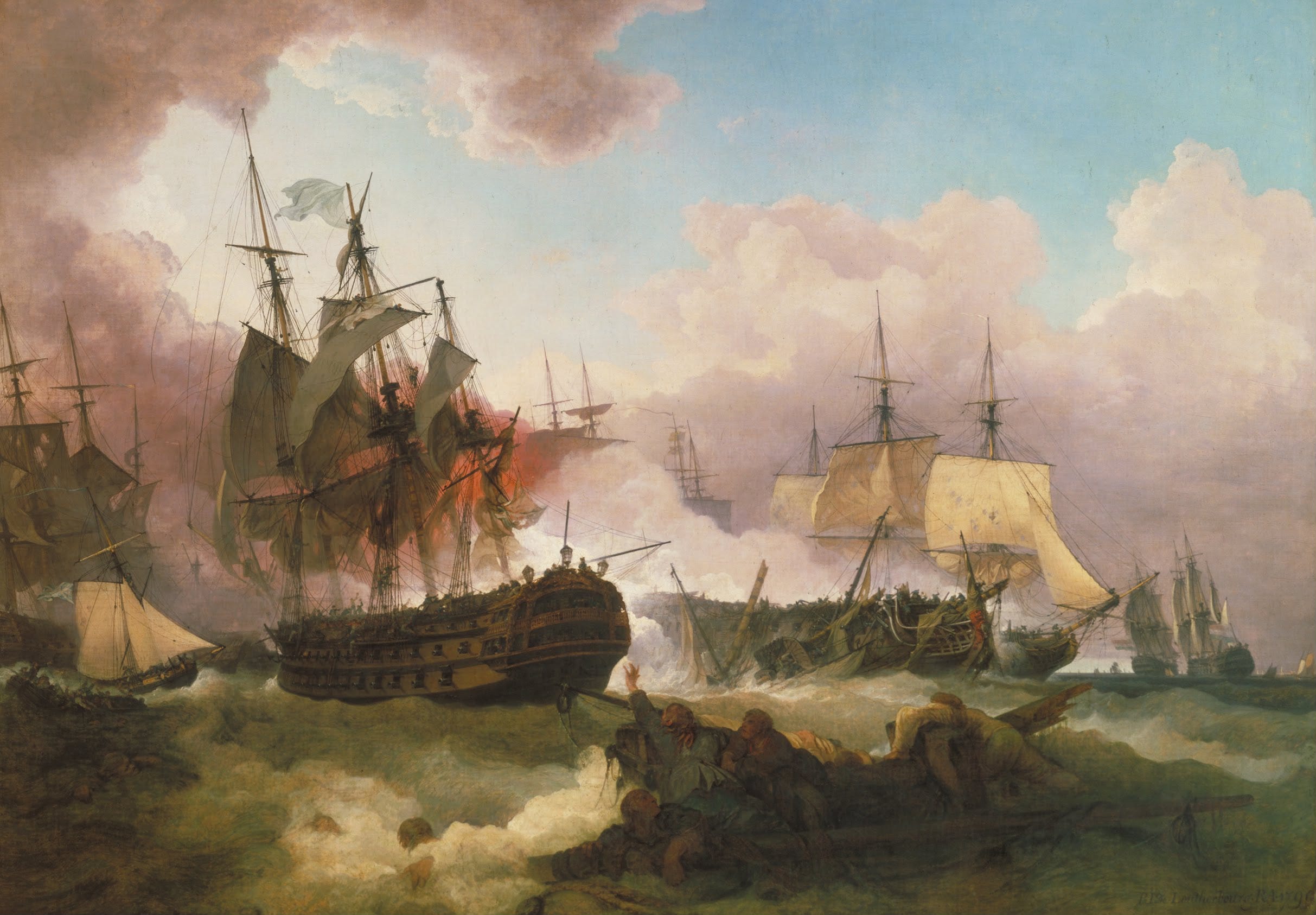
British admirals first came around to the tactic of breaking the line because of their unshakeable confidence in the quality of the crews that manned their ships. Part of this quality was the relentless drill of the sailors and their skilled handling of their ships in difficult conditions. As the preeminent (but not unchallenged) global naval power, the Royal Navy had many of the finest sailors in the world, all of whom had copious experience at sea in all sorts of conditions. French and Spanish fleets, meanwhile, tended, with increasing frequency, to be confined to port, or to only see service close to shore.
Gunnery practice was also relentless, and it became a trope that British gun crews could fire faster—sometimes twice as fast—as their counterparts in any other navy. This was broadly true, if somewhat exaggerated, and it permitted British admirals to overcome the sometimes significant disadvantages they faced in the size and power of their fleets.
And of course, the more the tactic was attempted, and the more it proved generally successful and decisive, the more that British admirals tended to wish to use it. As far as the Age of Sail was concerned, the tactic of trading broadsides in line of battle was dead.
Napoleon’s Impossible Recipe for Success
From the Elizabethan era (1558–1603) through to the 20th century, the surest guarantor of British sovereignty and defense against invasion, as with any island or continent-spanning nation, lay with the strength and power of her fleet. Though the British Army, which boasted its own impressive record at the dawn of the 19th century, took its natural place in the greater constellation of British national pride; it was unquestionably outshone by the Royal Navy, which was Britain’s first and final line of defense. The Royal Navy also defended British maritime commerce, the source of her wealth. The two combined to give her her considerable global influence as a great power. The best way to defend British soil, British maritime prosperity, and British diplomatic power, was to destroy the source of the danger itself—that is, the enemy’s navy.
The various Anglo-French wars of the 18th century often swirled around far-flung colonies in the Americas and India. Though many great land battles between the two powers were fought, it was the fleet actions that often decided the balance of power in peace negotiations between Paris and London. Time and time again, despite their best efforts, the well-led and -trained French navy was trounced, sometimes in spectacular fashion, by their British opponents. (The French navy, though occasionally victorious, never captured a British ship of the line as a result of a major fleet action.) The Spanish, the only other serious challenger to British naval might, did not fare any better, but nevertheless remained a serious strategic threat.
Napoleon had successfully brought Austria to heel twice, by force of will, in 1797 and in 1800.9 This he had done by rapid movements of his army, extreme force concentration, and relentless aggression. In prosecuting the new war against Britain, begun with a British declaration of war in May 1803, he hoped to employ the same principles, but this time at sea. French naval squadrons were divided between the Atlantic (the main ports being Brest and Rochefort) and the Mediterranean (Toulon was the traditional home of France’s Mediterranean fleet).
At the start of hostilities, the British naval blockade was quickly moved into place. Napoleon was aware of the quantitative and qualitative edge the British held at sea, but believed that by a complicated series of clever maneuvers, he could confound the British admirals, combine his fleets, and guarantee, if only for a few crucial days, dominance of the English Channel. Success in doing so would permit him to carry most or all of his vast army onto British soil. If he could achieve this, victory over Britain was guaranteed—the British Army was too feeble, and its seniormost leadership too inadequate, to handle the task.
Napoleon developed a series of schemes, modified over the course of 1804 and 1805, to effect this naval concentration of force. His plans relied on several facts: the French navy, though once vast and respectable, had been reduced to a shadow of its former royalist self by the Revolution. Though at the peak of the Revolutionary Wars the Republican navy counted 88 ships of the line, it was drastically reduced, thanks to naval losses (like the Nile in 1798) and budget constraints, to just 50 by early 1805. When counting only serviceable vessels, however, Napoleon had at hand just 38 ships of the line. (The British had 79 serviceable worldwide, though only about 56 were in Europe, with the balance in the Caribbean, the Indian Ocean, and in South Africa.) Each of the British blockading squadrons could therefore enjoy numerical superiority and, as we have seen, the Royal Navy in this era did not require superior numbers to win great victories.
For their part, the French could rely on their Spanish allies to bolster their numbers, but the Spanish navy, like the French, despite its impressive size and well-built ships, had suffered from years of neglect and corruption. As the pan-European war unfolded in early 1805, first with the intervention of Russia and then of Austria, Napoleon secured the diplomatic commitment of 29 Spanish ships of the line to the war effort. These, plus his own 38, could present a monstrous theoretical combined fleet of 67 ships of the line to challenge British control of the English Channel. (A single fleet at sea this large had not been seen since the Anglo-Dutch wars of the late 17th century.)
Put simply, Napoleon hoped to combine his scattered fleets with those of the Spanish, then sail up into the English Channel and escort his army over to the shores of England. All he needed was just a handful of days to cross unmolested by the Royal Navy—his navy need not necessarily prove successful in any engagement. Yet beneath the great number of assumptions of his eventual plan, there were numerous complications that would doom it to failure.
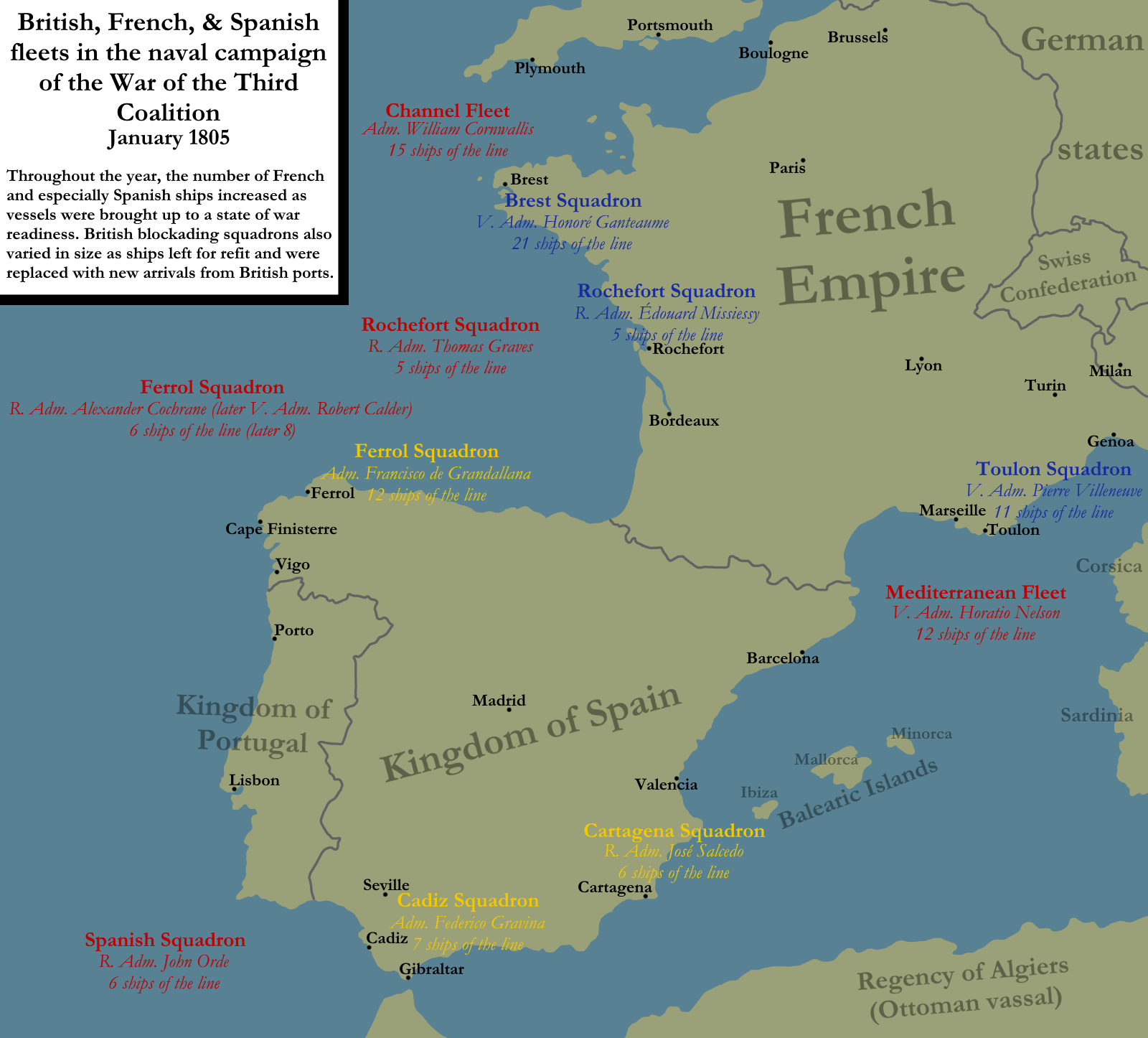
The French navy was divided into three main fleets in late winter 1805:
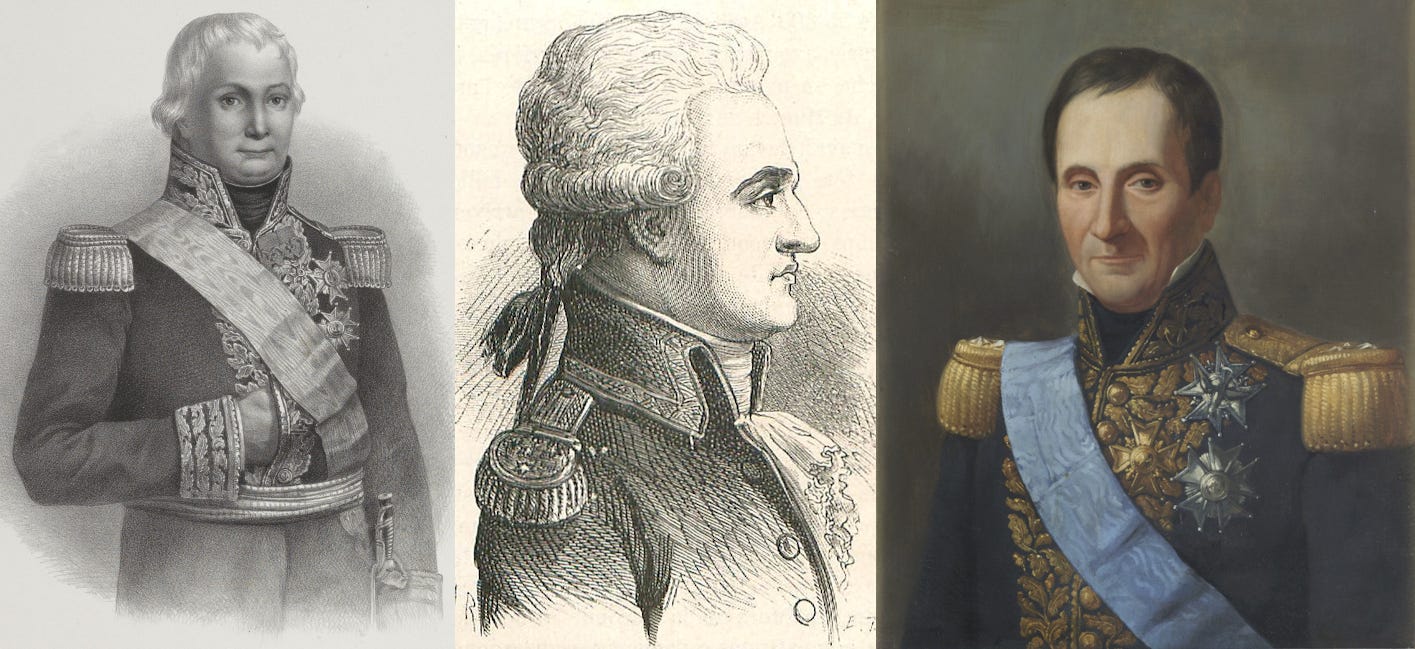
The Brest Squadron under Vice Admiral Honoré Ganteaume, boasting 21 ships of the line. Ganteaume, 50 years old in 1805, had been one of the lucky few crewmembers to survive the devastating explosion of the French flagship L’Orient at the Nile in 1798. When Napoleon decided to personally flee Egypt with a handful of his trusted subordinates and aides, it was Ganteaume, captain of the frigate Muiron, that brought the future emperor back to France, after which he enacted his coup and became military dictator. It was at least partly for this reason that he enjoyed Napoleon’s trust more than any other French admiral and, despite his juniority compared to Villeneuve, he earned the position of overall commander of the naval operation to seize the English Channel. Ganteaume raised his flag on the massive three-decked 118-gun Vengeur.
The Toulon (or Mediterranean) Squadron under Vice Admiral Pierre Charles Villeneuve, with 11 ships of the line. Villeneuve’s was just one of two ships to escape the disaster at the Nile. In most respects he was a capable seaman and admiral, but he did not command Napoleon’s admiration or even respect. Villeneuve was generally prudent, bordering sometimes on excessive timidity. He could be a metaphorical bundle of nerves, anxious at the prospect of unfavorable circumstances, constantly fearful of the enemy getting the better of him.10 Nevertheless, it was this prudence and timidity that allowed him to view, clear-eyed, the near-impossible orders Napoleon had given him and the other French admirals, and which he was nevertheless forced, with misgivings, to execute. The 42 year-old chose to raise his flag on the comparatively modest 80-gun ship Bucentaure, one of the largest in his fleet.
The Rochefort Squadron under Rear Admiral Édouard Thomas de Missiessy (later Rear Admiral Zacharie Allemand), composed of five ships of the line. As we will see, Missiessy, despite his own minor successes in the coming campaign, would receive a not-insignificant amount of the blame for its ultimate failure, proving himself unequal to Napoleon’s high expectations. His flagship was the 120-gun Majestueux.
The Spanish fleets available for the upcoming campaign were as follows:
The Ferrol (or Corunna) Squadron under Admiral Francisco de Grandallana, which comprised eight Spanish and an additional four French ships under Rear Admiral Antoine Louis de Gourdon. Ultimately, only part of this squadron played an active role in the coming events.
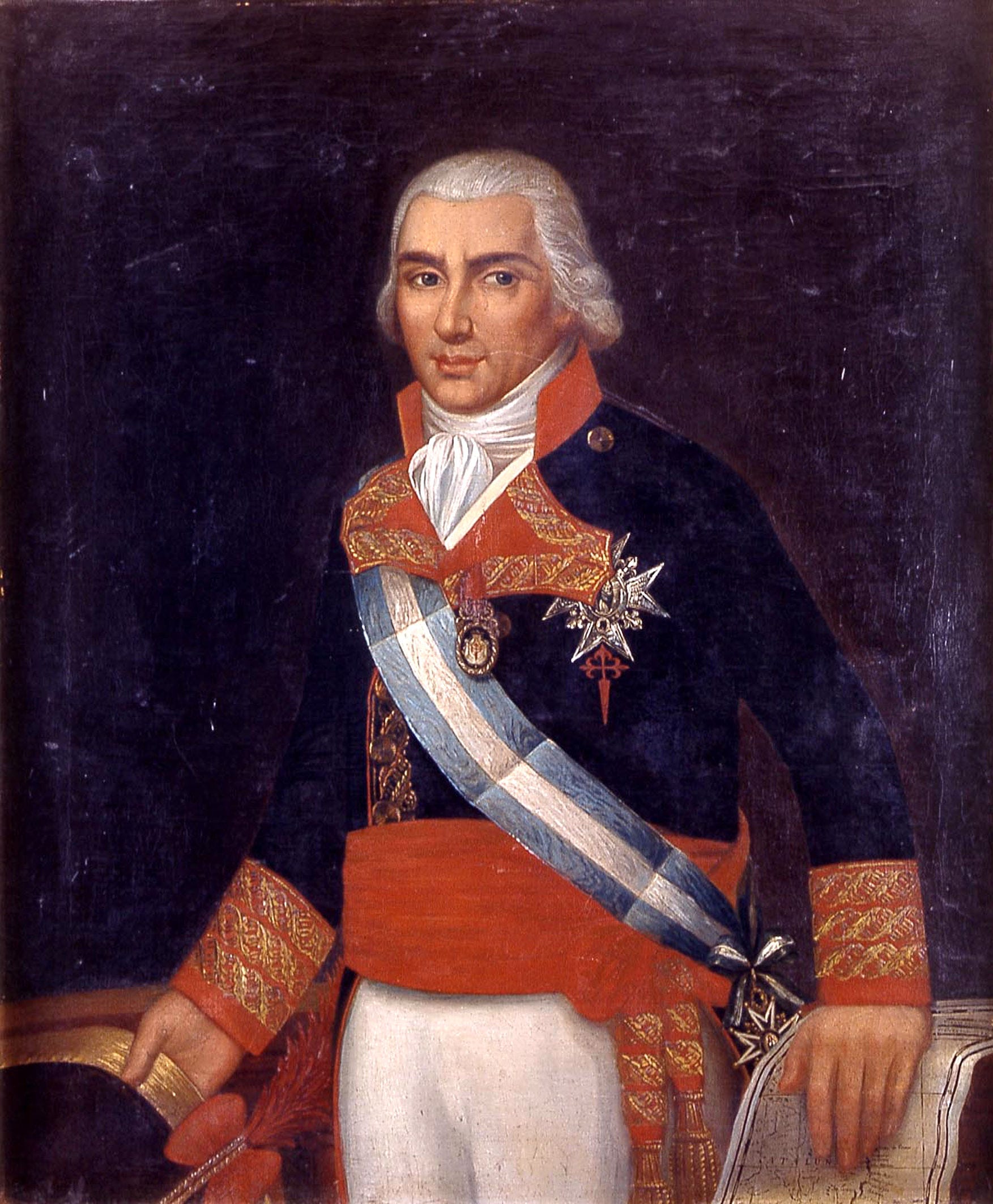
The Cadiz Squadron under Admiral Federico Gravina, with six Spanish ships of line plus the 74-gun French Aigle. Gravina was considered generally reliable, and brave in combat, as well as a rather talented organizer, but an unspectacular tactician. His administrative ability proved critical in ensuring much of his fleet was ready to sail when the French arrived. Still, many other Spanish ships in Cadiz required refitting, and were not ready for service until later in the year. In early 1805, he was 48 years old; he was 49 at Trafalgar. He hoisted his flag on the 80-gun Argonauta.
The Cartagena Squadron under Rear Admiral José Justo Salcedo y Arauco, with six ships of the line. Like the Ferrol Squadron, the Cartagena Squadron had a minimal role in future events thanks to issues of supply, manpower, and ship maintenance. Salcedo himself questioned the wisdom of the expedition.
One is struck by the dearth of Spanish ships immediately available for service. Such was the state of the Spanish navy, worsened by the corrupt and ineffective Bourbon government. It would take many more months to bring additional vessels up to a state of readiness. Even so, much of the Spanish navy’s vast fleet of powerful ships of the line would not see action in the coming campaign.
The vast British host arrayed against the primary ports of France and Spain was indeed formidable. Insofar as experience, talent, and firepower were concerned, it was perhaps the best collection of fleets ever arrayed in history to that point.
The large Channel Fleet, responsible for operations from Dover down to the southern tip of Portugal (hence its sometimes being referred to as the “Atlantic Fleet”), was commanded by 61 year-old Admiral William Cornwallis, younger brother of the general who surrendered to Washington at Yorktown. Cornwallis directly commanded 15 ships of the line blockading Ganteaume in Brest. Also answering to him were the smaller squadrons of Rear Admiral Sir Thomas Graves (cousin to the Thomas Graves who commanded at the Chesapeake in 1781), leading five ships in the blockade of Rochefort; Vice Admiral Sir John Orde and his five ships blockading Cadiz (technically independent but effectively answering to Cornwallis); and Rear Admiral Alexander Cochrane, aged 59 (soon to be replaced by Vice Admiral Sir Robert Calder (flagship captain of HMS Victory at Cape St. Vincent in 1797), whose six outnumbered ships bottled up Grandallana and Gourdon in Ferrol. (In March, as we will see, Calder arrived on station to reinforce the squadron to eight ships.) The strength of Cornwallis’ squadrons blockading France and Spain’s Atlantic ports amounted to 31 ships of the line (33 by March), whose crews, unlike those of their opponents, daily were benefiting from life and work at sea.
The job of bottling up Villeneuve in Toulon, as well as Salcedo’s fleet in Cartagena, fell to the comparatively diminutive British Mediterranean Fleet. This group of 12 ships of the line, led from the already venerable 104-gun flagship HMS Victory, was commanded by the 46 year-old Commander -in-Chief, Mediterranean Fleet, Vice Admiral Horatio Nelson.11 Nelson, son of a clergyman, blinded in one eye at Calvi (aged 35), his right arm amputated at Tenerife (aged 38), and injured twice more in other battles,12 was without question already Britain’s most famous sailor. Nelson had risen through the ranks unusually quickly for the age, achieving the rank of captain at 20 years old, and was always very conspicuous in battle, constantly and confidently putting himself in harm’s way.
Other very distinguished service aside, he had already led British fleets to two spectacular victories, annihilating the French Mediterranean Squadron at the Nile in 1798 (thereby stranding Napoleon and his army in Egypt), and destroying the Danish fleet at Copenhagen in 1801 (thereby guaranteeing its ships would never fall into French hands, though the odds of that were rather small). As will be seen, it was unsurprisingly this enterprising admiral, and his loyal fleet, which were to prove decisive in the upcoming campaign.
A false start: Nelson sees ghosts, January—February 1805
Napoleon’s schemes to concentrate his fleets and win the Channel finally crystallized into his plan of January 1805, the third such in two years. After scrapping one harebrained plan for Ganteaume to sail straight for Scotland and disembark an army to draw British attention northward prior to the attempted crossing of the Channel, Napoleon settled on something more realistic but far more complicated.
Missiessy in Rochefort and Villeneuve in Toulon would sail from their respective ports and head for the Caribbean with thousands of soldiers embarked. The first fleet to arrive would await the other, granting several weeks’ grace due to noncompliant weather or run-ins with the Royal Navy during the cross-Atlantic journey. In the meantime, the ships present would restock on supplies and disembark their troops to reinforce French possessions in the region (namely Santo Domingo), and attack other small British islands in the West Indies. Once united, with Villeneuve assuming overall command, the strengthened fleet would cross the Atlantic again, sail for Brest, and, with Ganteaume assuming command of the combined fleet of nearly 40 ships of the line, force the Channel in order to allow Napoleon’s army to cross. The Spanish did not play a role in this plan—instead the simultaneous breakout of Missiessy and Villeneuve was hoped to throw the British Admiralty into a panic, forcing them into launching a wild goose chase across the Atlantic and back again. The threat of re-establishing French power in the Caribbean was intended to be a threat to British commerce too great to ignore. But Napoleon, barely weeks into his reign as emperor, also did still retain the hope that French colonial ambitions could be reignited without expressly relying on the aid of Spain.
Missiessy sailed as ordered on January 11, 1805, and slipped past the blockade of Rochefort thanks to a thick fog. Rear Admiral Alexander Cochrane, with six ships of the line from the Ferrol Squadron, was ordered to pursue him. In Cochrane’s place was put Rear Admiral Calder, sent from England with additional ships to make up for the loss in strength of the blockade.
Villeneuve’s much larger fleet was not as lucky. Leaving on January 18, Villeneuve headed southwest, but his departure was almost immediately uncovered by Nelson, whose fleet was just beyond the horizon. A powerful gale struck the area the next day. Villeneuve’s ships were damaged and his inexperienced crews handled the situation poorly. Fearing disaster if he engaged the British—after all, he had a very healthy respect for Nelson’s abilities since Egypt—Villeneuve turned back around for Toulon, arriving on the 21st.
Nelson, however, was not aware of this. He knew that Villeneuve’s fleet had embarked army troops. Nelson also knew, thanks to intelligence reports from Britain’s ally Austria, that the French army in northern Italy had been mobilizing. Nelson suspected a possible invasion of the Papal States, in central Italy, or of Naples and Sicily further south. In that case, Villeneuve’s role would be to drop off troops somewhere on the coast, or to seize the Straits of Messina between Italy and Sicily. An attack on Sardinia or British-occupied Malta was also possible, or even a return to Egypt. Weighing his options, Nelson determined that Admiral Cornwallis and his vast armada could contend with Villeneuve if he transited the Straits of Gibraltar into the Atlantic. Nelson therefore sailed for the southern tip of Sardinia, hoping to catch Villeneuve on his theoretical journey east. His typical fiery personality burned with uncertainty that made him full of worry. “You will believe my anxiety,” he wrote on January 25 to Sir John Acton, working as an advisor in the court of King Ferdinand of Naples, “I have neither ate, drank or slept with any comfort since last Sunday [20th]. […] I consider the destruction of the enemy fleet of so much consequence, that I would gladly have half of mine burnt to effect their destruction. I am in a fever. God send I may find them!”
The following day he arrived off Cagliari, the largest city of Sardinia, and learned that the island was safe. He sailed then for the Straits of Messina. Arriving there on the 31st, he again found no reports of any French in the region. He began to worry that Villeneuve had indeed repaired to Toulon, and sent back several frigates to watch the port and create the illusion that the blockade was still in place. He continued east to Greece, arriving on February 2, then to Alexandria, on the Egyptian coast, on the 7th. The search was fruitless, and a furious Nelson sailed westward for Malta, then back to Sardinia. When he arrived again at Cagliari on February 27, he finally learned the truth: that Villeneuve had indeed sailed back to Toulon after the gale, leaving him to race needlessly across the Mediterranean for five weeks in, as he put it, “without exception the very worst weather I have ever seen.” This frustrating episode only furthered to stoke, rather than smother, his burning desire for battle with the French.
Missiessy, meanwhile, had arrived at Martinique on February 20, and thereafter strengthened the garrison of Santo Domingo with his 3500 embarked troops. Villeneuve contemplated rapid repairs to his ships and sortieing once more in compliance with Napoleon’s orders, but decided against it, citing the inexperience of his crews. “I declare to you,” he wrote to the navy minister, Denis Decrès, after returning to port,
that ships of the line thus equipped, short-handed, encumbered with troops, with superannuated or bad materials, vessels which lose their masts or sails at every puff of wind, and which in fine weather are constantly engaged in repairing the damages caused by the wind, or the inexperience of their sailors, are not fit to undertake anything.
Possibly unaware of the fact that the very letter may find itself on the emperor’s desk,13 Villeneuve indignantly added, with a clear air of vindication in second-guessing his sovereign, “I had a presentiment of this before I sailed; I have now only too painfully experienced it.” Napoleon’s response to the news was full of even more frustration. “[…] the men who command [the navy] are unused to the risks of command. What is to be done with admirals who allow their spirits to sink and resolve to be beaten home at the first damage they suffer?” he asked.14
In this manner, Napoleon betrayed his unfamiliarity with European naval traditions, and particularly the frequency with which admirals would be court-martialed for the slightest of failures. In many ways, naval warfare of the era was far less forgiving to admirals than land warfare was to generals. Villeneuve’s decision was calculated: better to return to port with a damaged fleet than continue sailing with it, inviting battle with an obviously superior enemy, and losing everything in a catastrophic defeat. Had Nelson and Villeneuve clashed in the days after the January 19 storm, there could only have been only one result. No superior leadership on Villeneuve’s part could have avoided it; the disadvantages he faced were systemic and deep. Nevertheless, fatefully, Napoleon did not remove Villeneuve from command.
The emperor adapted to the changed circumstances and revised his grand naval plan one last time. The orders were issued on March 2. Ganteaume and Villeneuve were each to embark small divisions of 3000 men apiece; Ganteaume would run the blockade outside Brest, lift the blockade of Ferrol, and unite with the fleet there under Grandallana (plus Gourdon’s French ships), then sail for Martinique, where it was hoped he would absorb Missiessy’s small squadron which had escaped in January. Villeneuve was to slip past Nelson, pick up the Spanish fleet in Cadiz (plus the attached French 74 Aigle), and rendezvous with Ganteaume and Missiessy in the West Indies. If he could not find either Ganteaume or Missiessy, Villeneuve was ordered to double back east for the Canaries, raid British shipping off the northwestern coast of Africa, and then sail back to Cadiz. In theory, the combined Franco-Spanish fleets would produce an armada of no fewer than 56 ships of the line, and possibly over 60 if additional Spanish vessels could be made serviceable in the months before Ganteaume’s and Villeneuve’s return from the Caribbean. It would be the largest fleet to ever sail into battle since the Anglo-Dutch War of the 1670s, and by far the most powerful.
Napoleon did not explain to Villeneuve the plan to unite the fleets and sail into the Channel. This was mentioned only to Ganteaume and to Major General Jacques Lauriston,15 commanding the embarked troops in Villeneuve’s fleet. Lauriston’s sealed orders (to be opened only once at sea) instructed him to impress upon Villeneuve the need for movement and action. This decision—keeping Villeneuve in the dark, giving an army general ill-defined leeway to behave questionably under uncertain circumstances—was another possibly fatal misstep in the opening of the campaign.
An American Excursion
Ganteaume prepared to sortie from Brest as early as March 24, but (accurately) counted Cornwallis’ fleet at 15 ships of the line, and requested clarification from Napoleon on his rules of engagement. Napoleon’s orders came back clearly. “A naval victory in existing circumstances can lead to nothing. Keep but one end in view: to fulfill your mission. Get to sea without an action.” The second fatal decision had been made. On March 27, Ganteaume sailed out of Brest under a fog, but winds blew it away as his ships began making their way into open water to reveal that the British Channel Fleet was approaching. A day-long dance between the fleets ensued, and at dawn on the 28th Ganteaume resigned to defeat and withdrew back into the safety of Brest. His fleet did not leave port again before the end of the campaign; by March 30, the Channel Fleet was reinforced with another six ships back from refit.
Villeneuve, meanwhile, had learned of Nelson’s pursuit of phantoms in January and February, and hedged that Nelson still believed that if a breakout by the French fleet were attempted, it would be toward the central or eastern Mediterranean. Only a pair of British frigates were watching Toulon from afar, and Villeneuve had received reports that Nelson’s main fleet was spotted off the coast of Barcelona to the southwest. After spending an additional two months preparing his fleet, Villeneuve set sail in the afternoon of March 30, headed south to cut between the Balearic Islands and Sardinia. The next day, April 1, he was alerted by a neutral Sicilian merchant vessel that Nelson’s fleet was actually just off the southern coast of Sardinia.
Nelson had indeed been spotted off the coast of Spain, but returned back to station near Sardinia several days later. His spotting off Barcelona had been intentional: his job was still to defend the central and eastern Mediterranean, and by “positioning” himself near Spain he hoped to goad Villeneuve into an expedition to Sardinia, Malta, Naples, Greece, or Egypt. On April 4, Nelson finally learned of Villeneuve’s departure from Toulon, but had no idea whatsoever of his intentions.
Breaking out
Villeneuve, learning of the (as it happened, unintentional) ambush laid by Nelson, turned west and made for Cartagena, arriving there on April 7. Napoleon’s orders did not mention Admiral Salcedo’s ships as playing any role in the coming campaign, but Villeneuve nevertheless hoped to incorporate his ships into the fleet. Salcedo played for time, arguing that his fleet was nowhere near ready for service (requiring possibly up to a week of final preparations), and that he lacked orders from Madrid. Villeneuve could not wait—he left before sunset.
By late afternoon the next day, Villeneuve’s pace had increased, and the Toulon Squadron transited the Strait of Gibraltar, albeit within sight of a pair of frigates attached to Rear Admiral Orde’s Spanish Squadron, tasked with blockading Cadiz. There Admiral Gravina’s Spanish Cadiz Squadron joined Villeneuve, increasing the fleet’s strength to 18 ships of the line. In this joining of forces, Brigadier General Reille,16 serving under Lauriston, said that the organizational ability and sense of alacrity displayed by Gravina “cannot be too highly praised,” though he criticized Villeneuve’s lack of attention to detail in ensuring the fleet sailed together; several Spanish ships lagged behind for the next five weeks during the trans-Atlantic crossing. This was to end up being a terrible omen before the end of the year.
All this time, Nelson remained south of Sardinia, awaiting word of where Villeneuve could possibly have gone. He again expressed his dismay in dramatic fashion by letter to a colleague: “I am in despair, I have not a word of news. I must do my best. God bless you. I am very very miserable.” Yet with each passing day and no sight of Villeneuve—and no reports of gales to have possibly sent the French reeling back into port—the prodigy began to seriously suspect that Villeneuve had made a break for the open Atlantic via Gibraltar. Two reports from fast British scouting ships on April 16 and 18 finally confirmed his fears, claiming that Villeneuve had been spotted near Cartagena sailing westward a week earlier. In his own way, now, Nelson was to be struck by misfortune. Terribly uncooperative weather and a series of gales prevented him from reaching Gibraltar until May 6, a glacial speed. He rested his crews for two days and stocked up on supplies. By that point, Villeneuve and Gravina were already eight days away from Martinique, 3700 miles away. Nelson was far behind—but he had the element of surprise. Villeneuve and Gravina thought they were in the clear, but the world’s most accomplished admiral was now on their tail.
Repairing to Europe
On May 20, Napoleon was struck by the first of many blows, though he could not have known it was also to be the smallest of them all: Missiessy’s Rochefort Squadron had returned to the city, unblooded and without Villeneuve. These ships, having arrived at Martinique on February 20, had left on March 28, two days before Villeneuve set sail from Toulon. Villeneuve’s orders were to wait up to six weeks for either Missiessy or Ganteaume before re-crossing the Atlantic. It would be a slow six weeks.
The French admiral contemplated striking several nearby British island garrisons, but felt it would be impossible to commit the significant time and resources to these ventures while also keeping watch, in a timely manner, for the Brest Squadron. Villeneuve was also spooked by reports of a powerful British squadron roaming the Caribbean and based out of Jamaica or the Leeward Islands; this was Cochrane’s fleet, dispatched to pursue Missiessy. All these factors combined for general inaction, though he did allow himself to attack and capture the small island off Martinique known as HMS Diamond Rock, taking about 100 soldiers prisoner.
That same day, May 30, Villeneuve received two separate delayed messages from France, both critical to the outcome of the campaign. The first, dated April 17, said that Rear Admiral Charles René Magon, commanding two newly refitted ships of the line that had escaped the Rochefort blockade prior to Missiessy’s return to France, were en route to reinforce the fleet. It also ordered Villeneuve to wait four weeks from Magon’s arrival, then return to Ferrol. From there, combining forces with admirals Grandallana and Gourdan, he was to sail for Brest, break Cornwallis’ blockade, join with Ganteaume, and escort Napoleon’s army to Britain at Boulogne. Not only was Villeneuve just now being informed definitively of the plan to seize the English Channel, but the language was unclear: he was unsure if Ganteaume was to remain the senior admiral, or if he was to now become the overall commander of the incipient Allied armada. The second note, dated April 29 and written by navy minister Decrès, claimed that “Nelson has gone off to Egypt after you.”
Not only have we established that this was not the case, but Nelson was far closer than even Nelson himself realized. On June 4, Magon arrived off Martinique, bringing Villeneuve’s strength to 20 ships of the line. At that same moment, Nelson’s 12-ship Mediterranean Fleet, almost 4000 miles removed from its proper station, was sailing into harbor at Barbados. The two fleets were just 140 miles apart. Nelson was on the cusp of finally bringing Villeneuve to battle after an agonizing five months of waiting and misdirection.
The next day, June 5, Villeneuve weighed anchor and sailed northward, scooping up disparate French and Spanish army garrisons and essentially looking for targets of opportunity. On the 8th he fell upon a large convoy of British merchant ships, capturing all but one of the fifteen present. He was stunned into disbelief when sailors were interrogated about British fleets in the region: Nelson, they claimed, was at Barbados. After a brief discussion, Villeneuve and Gravina agreed that their orders no longer sufficed for the radically altered situation, and that the danger of Nelson and Cochrane joining forces—combining for 17 ships of the line, though they suspected more—would be fatal to their fleet. Thus they decided to head back to Europe, bound for Ferrol.
Nelson, meanwhile, sailed southwest from Barbados on the morning of June 5, one day after arriving. He was headed for Trinidad, just 20 miles from the South American mainland. “There is no doubt in any of the Generals’ or Admirals’ minds,” he wrote, “but that Tobago and Trinidad are the Enemy’s objects; and […] I am anxious in the extreme to engage their 18 sail of the line […].” The British garrison commander on Barbados had told him that a nearby signals station had seen the French fleet sailing south on May 28, so this guess was not altogether unreasonable, particularly since Nelson had no other information to go on. It wasn’t until his arrival on June 7 that he once again found nothing. As the fleet departed, headed back northward from Trinidad the following day, he received word from a packet ship about the capture of HMS Diamond Rock, one week and 260 miles distant. Nelson was furious, again reminded of his doomed chase across the Mediterranean five months ago. “I lost the opportunity of fighting the enemy,” he fumed to his friends as the fleet raced northward toward Martinique and then Antigua. “But God is just, and I may be repaid for all my moments of anxiety.”
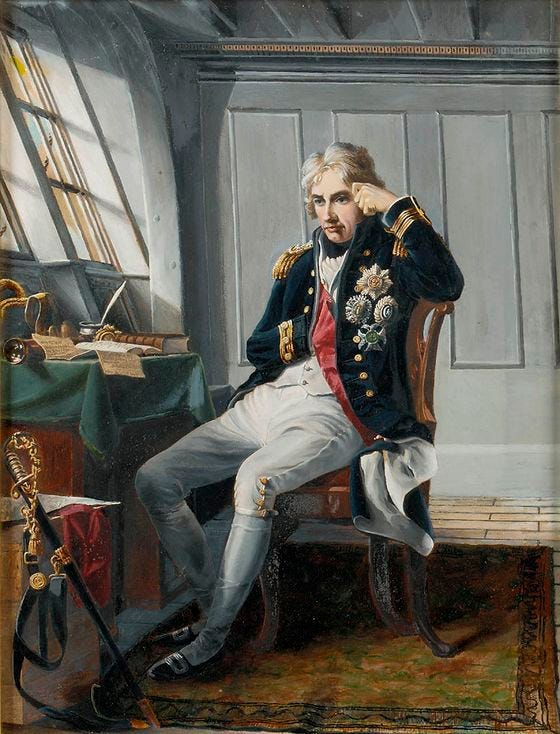
It was not to be—at least not yet. Villeneuve and Gravina, fresh off the newfound knowledge that Nelson was with them in the Caribbean, left Antigua and set sail for Europe on June 11. Nelson, making great time, arrived on June 12, and, learning he had missed the French and Spanish by just one day, became as a man on fire, knowing he was finally within reach of his enemy. On the morning of June 13, he set out east over the Atlantic. Nelson believed Villeneuve was headed back for the Mediterranean, or perhaps Cadiz, and so the British took a more southerly course. He did not yet know that the Combined Fleet was making for Ferrol, on the northwestern coast of Spain. Though Napoleon’s wishes in capturing numerous British islands in the Caribbean had not been fulfilled, and Ganteaume had failed to break the Brest blockade, his plan for the unification of the Allied fleets was, thus far, otherwise going to plan.
Nelson sent the small brig HMS Curieux ahead of the fleet with urgent reports to the Admiralty. Taking a more northerly course than the rest of the fleet, Captain George Bettesworth suddenly spotted Villeneuve’s fleet on June 19, 900 miles from Antigua. He was shocked—this course would not take the enemy to Cadiz or Toulon, but to the northern coast of Spain, or western France. Doubling back to inform Nelson was not realistic as the search would take days or even weeks; Bettesworth’s only choice was to race back to Britain as quickly as possible and sound the alarm. Even Nelson, with astounding foresight, decided mid-journey that the enemy could perhaps divert to Ferrol. On June 19, the same day Bettesworth found Villeneuve, Nelson sent two more fast ships ahead to warn Calder and the blockading squadron of this potential development.
The journey back to Europe for both the Allies and the British was against contrary winds and thus painfully slow. Nelson arrived at Gibraltar on July 19, and in his usual manner lamented the knowledge that Villeneuve was not there, nor had he passed through the Straits: “No French fleet, nor any information about them—how sorrowful this makes me, but I cannot help myself!” he wrote to a member of the Admiralty. His intuition of June 19 was right, but he was still not sure where the enemy had gone. He therefore felt that he had only one choice. He restocked on provisions and rested his crews for several days—he stepped ashore for the first time since June 1803—then turned northwest, past Cadiz, to rendezvous with Cornwallis’ fleet off Brest. The fleet arrived on August 15, then Nelson continued to Britain aboard HMS Victory. He spent one month in England and then departed, for the last time, on September 14.
Late in the evening of July 8, news reached the Admiralty of Bettesworth’s discovery. Admiral Lord Barham, the 78 year-old First Lord of the Admiralty,17 was forced to make a difficult decision without delay. With news in hand of Villeneuve’s true course, plus Nelson’s report, he read events with remarkable clairvoyance. He scribbled a note that was then delivered to Cornwallis off Brest:
My idea is to send the intelligence immediately to Admiral Cornwallis who may be directed to strengthen Sir Robert Calder’s squadron with the Rocheforte [sic] squadron and as many ships of his own as will make them up to 15, to cruise off Cape Finisterre from 10 to 50 leagues to the west, to stand to the southward and westward […] for 10 days. [Blockading] Cadiz can be left to Nelson. 9th July.
By July 13, Cornwallis’ compliant orders reached Rear Admiral Charles Stirling, newly-appointed commander of the Rochefort blockade, and he brought his five ships of the line west to join Calder’s Ferrol Squadron. Once joined together on the 15th, Calder sailed to the appointed spot west of Cape Finisterre, hoping to encounter Villeneuve. He only had to wait one week.
No Good Deed: The Battle of Cape Finisterre, July 22
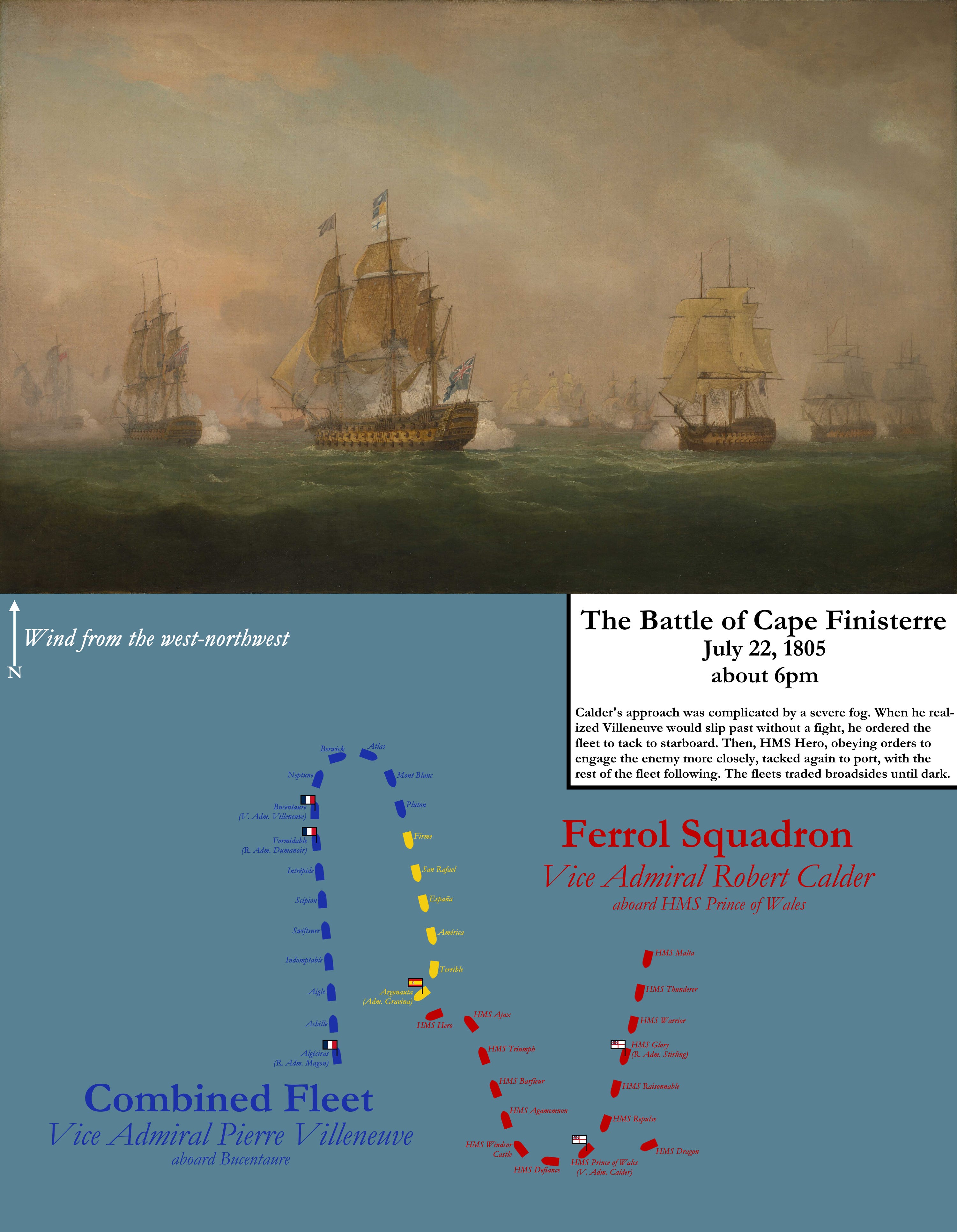
When Calder sighted sails on the horizon to the southwest, he ordered the decks cleared for action. His fleet comprised fifteen ships of the line sailing in two columns to the southwest, on a starboard tack with a west-northwesterly wind. Villeneuve had at his disposal twenty ships of the line (six of them Spanish) plus seven French heavy frigates. His fleet was sailing eastward in three columns, the southernmost composed entirely of Gravina’s Spaniards. When Calder was sighted, Villeneuve ordered that the fleet wear northward. Gravina’s southernmost squadron received “right of way” as it passed the French squadrons and took the van of the fleet as it formed a line of battle.
Villeneuve sought to maintain the weather gage, but Calder intentionally forfeited it: his interpretation of his orders, and the general strategic situation, was that he would be better served keeping his fleet between Villeneuve and Franco-Spanish sanctuary at Ferrol. Villeneuve’s orders to Gravina to have him take the van sacrificed crucial time, however, and risked Calder seizing the gage if he so chose. Villeneuve has rightly been criticized for this in the centuries hence, but there was some fair, if perhaps insufficient, reasoning behind it, including the political considerations of granting his Spanish allies the “position of honor” in leading the fleet into battle. Perhaps more practically, Gravina had won his trust as a respectable and skilled seaman and naval officer, even if Spanish crews, according to Tunstall, were “particularly poor.”18
Rolling banks of fog on the ocean surface materialized, vanished, and returned throughout the day, giving the British and the Allies only fleeting glimpses of each other’s forces. Villeneuve hoped to scare off the British with a few broadsides, then continue north and east around Calder’s flank into port at Ferrol. As the distance closed to about six or seven miles, Calder ordered a tack to starboard, headed roughly northward. This would permit his ships, if they could catch up, to engage the more isolated sections of Villeneuve’s rear and part of his center. In his own way, Calder hoped to achieve force concentration against part of the Combined Fleet, though without breaking the line—at least not yet. At 5:09pm, Calder signaled to the fleet to “engage the enemy more closely,” a typically game order anticipating immediate, successful, and decisive action.
Calder’s plan was frustrated by both the weather and Villeneuve himself. Villeneuve could see the British tacking northward, and signaled to Gravina, in the van, to wear in succession to starboard, leading the fleet back south. Villeneuve wisely feared a British attempt to attack his more isolated rearward ships, which were still forming up and struggling to get into line. What followed was a scene not to be repeated for another century until Tsushima and Jutland: Gravina’s squadron, unseen by the British, was sailing through a fog bank directly for the enemy. Neither Villeneuve nor Gravina expected to come face to face with the British at close range. Yet at about 5:30pm, Gravina’s flagship Argonauta, leading the Allied line, emerged from the fog off the port bow of HMS Hero, leading the British line, on opposite tacks.
Hero’s captain, Alan Gardner (a 12-year old midshipman at the Battle of the Saintes, in which he was wounded), made a split-second decision on his own initiative. Taking into account the order to “engage more closely” the enemy, as well as the general indecisiveness of two fleets broadsiding one another on opposite tacks (as discussed previously), Gardner ordered a hard turn to larboard in an attempt to rake Argonauta.
When Argonauta and Villeneuve’s flagship Bucentaure had crossed paths as the Spanish sailed south, Villeneuve had called over to Gravina by speaking trumpet and ordered him to turn to starboard, headed southwest, to sail close to and protect the disorganized rear of the fleet. Thus when Hero appeared on his port bow, Gravina immediately ordered that the ship come to. For a few tense moments the ships closed the distance and turned together to the southwest; but Hero had to tack through the wind, while Argonauta enjoyed the advantage of jibing, which was faster. Thus Gravina’s flagship let loose the first shots of the battle, a close-range broadside that virtually raked the unlucky Hero afore.
The violence of Argonauta’s starboard turn, however, meant that the broadside was largely ineffectual, with many shots landing short, and the swells meant that her lower gun deck, carrying the most powerful guns on board, could not be fired. Calder, alerted to the sudden sounds of battle and seeing Hero suddenly turning to port, divined what had occurred and immediately ordered the fleet to tack in succession once again, following Hero to port and attempting to bring on a general engagement. One by one the Spanish and British ships turned in succession and began to trade broadsides. Cannon smoke mixed with the rolling fog banks to further reduce the already poor visibility. The fog then thickened suddenly to the point that some of the rearmost ships of Calder’s column, unable to read Calder’s signals or determine the path of the fleet, continued sailing northward, trading mostly ineffectual broadsides with part of the French center and rear.
Fighting continued after nightfall, Calder’s own orders to disengage being impossible to read in the fog and smoke. The worst of the action befell Gravina’s final two ships, the 80-gun San Rafael and 74-gun Firme, which suffered a combined 80 killed and 150 wounded; both ships struck and were taken captive. Total Franco-Spanish losses were about 500 men plus an additional 1200 Spanish prisoners (many of whom were wounded). Calder suffered 39 dead and 159 wounded, though several ships, especially the 98-gun second rate HMS Windsor Castle, were heavily damaged. Calder could easily claim the victory with two prizes, and happily did so in his report, calling it a “very decisive action.”
By the standards of most of the 18th century, it was indeed a convincing British victory. Villeneuve resolutely reported, after continuing east to port, that “the field of battle remained ours,” with multiple British ships very heavily damaged. Rear Admiral Magon, Villeneuve’s diametric opposite in his preference for aggressive action, was so furious with the fleet disengaging and not renewing battle that, passing Villeneuve’s flagship aboard his own ship Algésiras, he threw everything he could in his direction in an almost comical fit of fury—including his spyglass and dress wig, which fell into the water between the ships.
But to Calder’s demise, it was no longer 1747 or 1759. At dawn the following day, both fleets were still in sight of one another, but damages suffered and the dissolution of both lines rendered an organized battle impossible. Calder spent the 23rd and 24th reorganizing his fleet and securing his two Spanish prizes, but he feared a second engagement—Grandallana was still in port in Ferrol. On the 25th, the fleets finally broke contact, with Calder heading northeast toward Brest and Villeneuve southeast to Vigo.
British victories at Cape St. Vincent, the First of June, and the Nile had spoiled the British public. Calder’s victory was received grimly in the papers. Cornwallis was actually pleased with his subordinate’s performance, as were the other captains of the fleet and even Nelson when he learned of the battle—“criticism by landsmen and politicians always united the navy,” writes Howarth—but the public outcry against Calder, painting him as a coward who refused to crush the French and Spanish when given the chance, gave the Admiralty pause. Calder eventually requested and was granted a court martial to clear his name. Events between the battle and the court martial itself, as we will see, were unfavorable to his case.
The Navy absolved him from accusations of cowardice, but found him to have made a serious error of judgment, unofficially ending his service at sea. Calder was a competent commander, well-liked and respected, and certainly he had won a victory that bruised the spirits of French and Spanish sailors and officers alike, nevermind having captured two enemy ships while outnumbered. As has been pointed out many times before, had Britain been less fortunate—which is to say, had the present campaign not terminated in an overwhelmingly decisive British success by the end of the year—Calder’s career would not have been thusly tarnished. Nevertheless, his “failure” to press home his advantage probably rendered a greater service to Britain than if he had actually done so. His misfortune, it turned out, was the country’s benefit. After the coming events of October, Villeneuve, too, would have time to lament the outcome of the battle for similar reasons. “I wish Sir Robert and I had fought it out that day,” he pined. “He would not be in his present position, nor I in mine.” For now, however, Calder remained in command off the coast of Spain, and Villeneuve’s battered but intact fleet sailed into Vigo on July 28. After the most badly-needed repairs were made, he sailed north, hugging the coast, into Ferrol, which offered better sanctuary for the defeated Combined Fleet.
