
One More Such Defeat
The Battle of Malplaquet, 1709

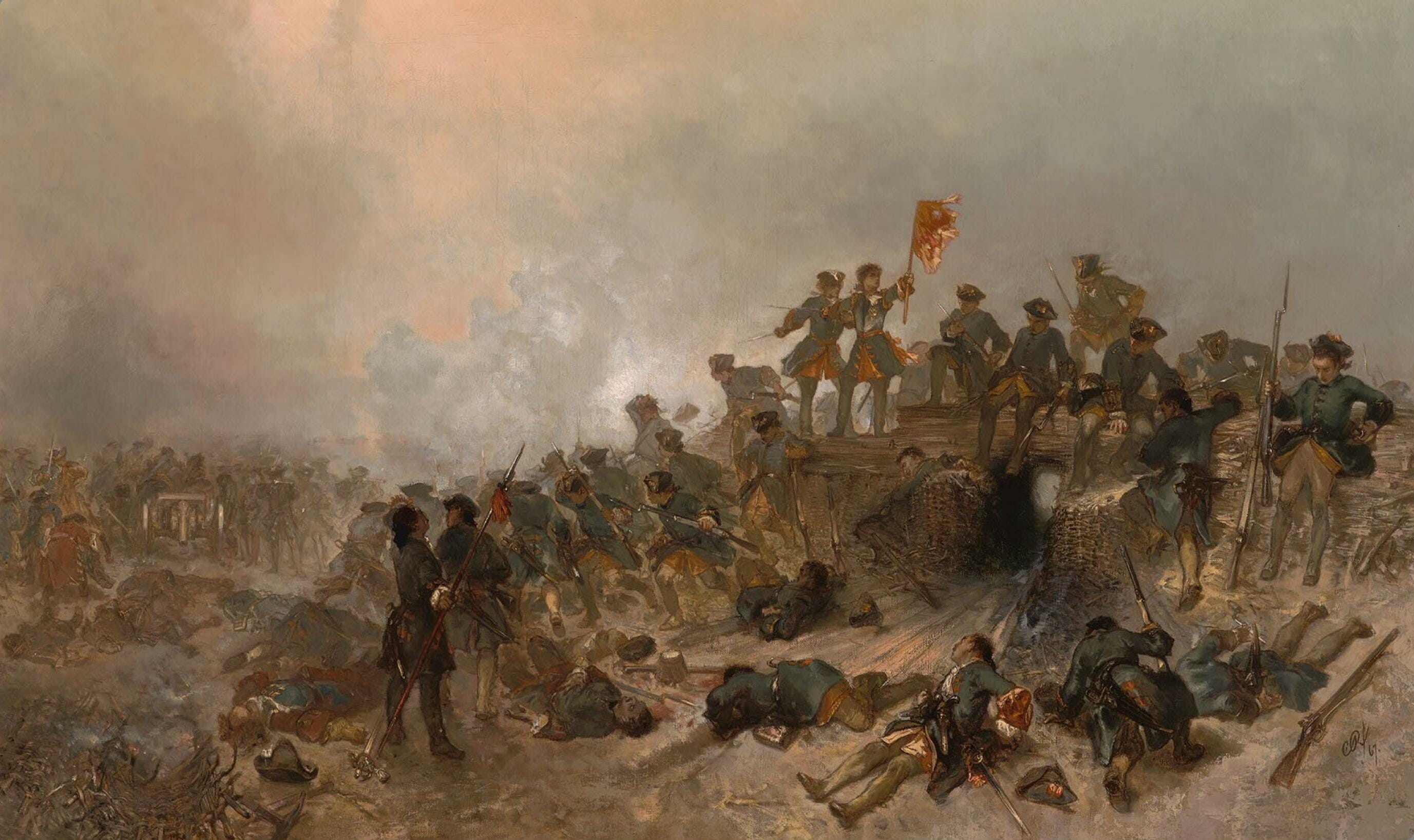
The rolling fields near the small city of Asculum in southern Italy played host, in 279 BC, to an orgy of blood. Pyrrhus, Greek king of Epirus on the Ionian Sea and cousin to Alexander the Great, had invaded Italy, and one year after his first great but bloody victory over Rome at Heraclea, he was trying his luck once more.
The exact army strengths are unknown, and the ancient sources disagree, though Pyrrhus and his opponent, the consul Publius Decius Mus, probably each had about 50,000 men. It was the second of three battles he would fight against the Romans, following his convincing but sanguinary success at Heraclea the year previous. It was an intense and, for Antiquity, rare two-day battle that began with a Roman assault on the first day amid broken and uneven terrain. This had been an intentional decision by Decius: it would negate the strength of Pyrrhus’ unwieldy phalanx infantry and limit the use of his terrifying war elephants, which had played a decisive role at Heraclea. On the second day, Pyrrhus redeployed his army onto more favorable open terrain. The ensuing fight was sharp and bloody: thousands on both sides, and perhaps over 10,000, were killed. Though probably outnumbered, Pyrrhus and his Greeks, supported by troops contributed by other Italian peoples, had won the day, with Decius’ army, though not destroyed, in headlong retreat. Pyrrhus seemed to be unstoppable—but he had secured victory at grievous cost.
Plutarch tells us:
The two armies separated, and we are told that Pyrrhus said to one who was congratulating him on his victory, ‘If we are victorious in one more battle with the Romans, we shall be utterly ruined.’ For he had lost a great part of the forces with which he came, and all his friends and generals except a few; moreover, he had no others whom he could summon from home, and he saw that his allies in Italy were becoming indifferent, while the army of the Romans, as if from a fountain gushing forth indoors, was easily and speedily filled up again, and they did not lose courage in defeat; nay, their wrath gave them all the more vigor and determination for the war.
Sure enough, four years later, in 275 BC, the Roman army—built out of a nascent, dynamic, and explosive civilization that was always learning from its enemies—decisively defeated Pyrrhus at Beneventum, near Naples. The core of Epirus’ elite army was ground down and destroyed after years of war. He had won two great victories, yes; but with nothing to show for it. It was the end of Pyrrhus’ escapades in Italy. The pill was even more bitter to swallow knowing that his first two battles against Rome had been great and hard-fought successes. He soon afterward left for Greece, later to die in battle against Macedon and Sparta in 272.
By the time of Asculum, Pyrrhus had been fighting on Roman soil for a year, and would continue doing so for another three afterward. In a similar manner, for half a decade from 1704, John Churchill, better known as the Duke of Marlborough,1 had been fighting on the French frontier2 against a relentless and determined opponent. Each defeat he inflicted against the French—at Blenheim (1704), where he saved Vienna from possible attack; at Ramillies (1706), where he drove the French out of most of Belgium; and at Oudenarde (1708), where he reversed a year’s worth of hard-fought French gains—were almost catastrophic in scope. Though the strength of the combatants in each battle had been approximately equal (52,000, 60,000, and 80,000 respectively), Marlborough managed to inflict a total of about 63,000 casualties—killed, wounded, and captured—for little more than 20,000 of his own. French losses in all three battles could themselves, at least in manpower, form an entirely new field army larger than either one of those at Blenheim. And yet these three titanic victories, plus other French reversals in Germany and in Italy, could not bring Bourbon France, bruised as she was, to heel. And so going into the campaigning season of 1709, Marlborough, his subordinates, and his allies all hoped to deliver the knockout blow against their enemies, and finally force the stubborn Sun King to sue for peace.
Pyrrhus’ legacy as a commander is contentious; Marlborough’s is not. His hard-won reputation as England’s finest soldier, and probably the best field commander ever produced by the British Isles, can reasonably be challenged only by that of the Duke of Wellington. Malplaquet was the only serious blemish on his career, even though, in essence, it was his most hard-fought victory.
Malplaquet was the bloodiest battle of the 1700s, with losses on both sides comparable to those at Napoleon’s greatest victory, Austerlitz, in 1805. In a letter to King Louis XIV shortly after September 11, 1709, the duc de Villars, Marshal of France, said: “If God give us the grace to lose such another battle, Your Majesty may reckon that Your enemies are destroyed.” In a time when aristocrats had studied Classics from youth as a mater of course, this was no accidental allusion to Plutarch. In fact, Villars, despite his bluster, had no way of knowing it, and indeed no one knew it yet; but in his battlefield defeat, he had paradoxically saved France from total vanquishment, and confirmed Louis’ legacy as one of history’s greatest statesmen.
European Warfare in 1700
In general, at the start of the 18th century, the manner in which wars were fought did not, on the surface, look much different from those of later decades—the Seven Years War, the American Revolution, or the Napoleonic Wars. There are many elements which are familiar, both in appearance and structure, but in doctrine, thinking, and ideas of how to fight battles and wars, things appeared more crude and unrefined. The first decades of the century constituted a period where states were completing the transition from an archaic post-medieval army of levies, where some or even most were armed with pikes and swords, to a standing army that was professional and highly-organized, led at times by educated soldiers, and buttressed in times of war by systematized conscription.
Artillery: Nascent and not yet crucial
Though he was a diligent and enthusiastic student of military history, Napoleon would still have found the battlefields of the War of the Spanish Succession a completely different breast from those he experienced throughout his career. His favorite service branch, the artillery—which he had joined as a sub-lieutenant in 1785, and with which he first made a name for himself—was employed in a manner very different even from the mid-1700s.
The progress of a battle was usually much more formalized, with some elements of pageantry. Battles usually opened with an artillery barrage, with each army’s heavy field pieces dragged to the front and deployed in one single line in front of the army. Cannons were heavier, standardization of equipment was poorer, and metallurgical techniques were still unrefined. Like the general army supply trains, there was much more equipment for the artillery batteries than in later decades. Supply convoys and marching columns, therefore, could be much larger and more difficult to manage. Army logistics had not yet improved to the near-science it would eventually attain.
Thanks to the great number of wagons and beasts of burden required, generals of the era were already recognizing the potentially fatal slowness of artillery trains on the march. At the start of the War of the Spanish Succession, it was general practice for the artillery trains to be relegated to the rear of the marching columns. Because battles were usually opened with grand artillery barrages along the whole line, this meant that preparing for a battle typically entailed a significant time delay. Encounter battles were extremely rare, and when they occurred they usually involved only smaller independent forces. (An exception was Marlborough’s great 1706 victory at Oudenarde.) Furthermore, both armies would generally have to agree to giving battle.
Just several years into the war, generals began to place greater priority on the flexibility of the artillery arm, insofar as such flexibility could be achieved in this early period. An army’s artillery train would then be divided up into smaller artillery brigades, with at least one posted close to the front of the marching column. The natural result of this trend was that an army could afford to be more aggressive, and seek to bring the enemy to battle before they could escape. Such advantages played directly into the proclivities of generals like Marlborough, Eugene, and Villars.
It was also in the era of Louis XIV that generals adopted and abided by the principle of “one gun per 1000 men” in a field army. After the War of the Spanish Succession, this ratio steadily grew. Clausewitz noted in On War (“Vom Kriege”), 1831, that,
[…] since the time of Frederick the Great [r. 1740–1786], the proportionate strength of artillery has remained fairly constant: two or three guns per thousand men—that is at the outset of a campaign. In the course of operations guns are not lost as fast as men, and so their proportion is a good deal higher by the end; possibly arriving at a ratio of three, four, or five guns per thousand men.
So it can therefore be determined that between the War of the Spanish Succession (1701–14) and the reign of Frederick the Great in the 1740s—a gap of just thirty years—artillery became more numerous, and significantly more important, within European armies. Chandler attributes this to the principle, at the start of the century, of the artillery having a primarily defensive character. Attacks were conducted by infantry and cavalry, and were launched against redoubts and earthworks held by artillery and supported by infantry. He notes that there were exceptions that proved the rule:
There were, however, somewhat more aggressive ideas prevalent in those armies that had extemporized a form of regimental artillery, more particularly the English, Austrian, Swedish, and Dutch, where the infantry battalions’ 3-pounders accompanied their parent formations in attack as well as defense. […] Nevertheless, until the greater number of artillery pieces became lighter and handier, their role remained fundamentally defensive and static, and these considerations did much to determine the number of guns needed by an army in the field.
Theorists and generals of the time held strong to the principle of one gun per 1000 men. It is hard to pin down exactly when this idea first sprouted, but it was a near-universal by about 1690. Thus it can be stated simply: the army’s artillery train of 4-, 6-, 8-, 12-, and 16-pounders performed an almost strictly defensive duty, stretched out along the length of the battlefield; but some armies, particularly France’s enemies, were beginning to experiment with the offensive use of smaller artillery pieces attached directly to the infantry regiments. These smaller pieces were light enough that they could generally be moved about on the battlefield without too much trouble. By the middle of the century, artillery began to take a more prominent and offensive role. But in the days of Marlborough, Eugene, and Villars, that was a long way off.
Napoleon famously said that “great battles are won by artillery”; a general in the 1690s or early 1700s would probably have disagreed, but even a man like the Duke of Marlborough, when writing to one of his generals tasked with escorting a large column of guns and supplies, said, “For God’s sake be sure you do not risk the cannon.” Inscribed on every artillery piece in Louis XIV’s army was the phrase, “The last argument of the king” (ultima ratio regis). Whether this referred to artillery in particular, or in general the legendary armies of the Sun King, is difficult to establish. Nevertheless, the spectacle of a great line of artillery issuing forth smoke and fire, accompanied by its dreadful great rumble, was already recognized to have a tangible battlefield impact, not even to speak of its psychological effect on its victims. Artillery pieces were expensive and time-consuming to produce, and educated and skilled artillery officers, knowledgeable in trigonometry, were hard to come by. Artillery therefore had its utility, and an army that hoped for victory could not do without it. It was not the decisive arm on the battlefield, however.
Infantry: Matchlock, flintlock, pike, and fire
Compared to the artillery, infantry at the dawn and end of the 18th century did not differ that much in organization or employ. The infantry were still organized into regiments, and below that into battalions (though newer regiments raised in wartime could sometimes comprise just one battalion; older, more established regiments could have three or even four). Unit sizes generally remained the same as in later conflicts: a battalion on campaign, especially early in a conflict, could be expected to be 600–800 men, and fairly close to its authorized “paper” strength. Constant warfare and the depletion of manpower, however, could still take its toll, especially if logistical capabilities for reinforcement and replenishment were far outstripped by the sheer number of casualties, from all causes, in the field armies. By early 1709, it was rare to see a French infantry battalion muster more than 400 men. English and Austrian armies were not hit nearly as hard.
The primary difference from later wars was that these battalions generally stuck to a single formation of four, five, or even six ranks deep, depending on circumstances and desired frontage. As the war progressed and the need for increased firepower became apparent—and as the terrible casualties of combat and disease took their toll in the 13-year conflict—the combatants decreased the number of ranks they deployed in, generally settling for three or four. (By the Napoleonic Wars, the British enjoyed using just two-rank line formations for their infantry.) “Training” for men generally consisted of whatever they learned (and, more rarely, were taught) once they were sent to their units shortly after being enlisted. It was not until the mid-18th century that most armies finally managed to begin standardization of training methods and regimens, though even this proved imperfect, and implementation remained uneven, until the 19th century. The 17th century was the time in which the first modern professional armies were born, but they were still embryonic by 1700.
Firepower was improving by leaps and bounds. By the turn of the century, armies were phasing out the matchlock in favor of the flintlock, which offered a slightly higher rate of fire, was safer, and was more logistically feasible. Flintlocks could also be used with new-model “socket” bayonets which could be attached and reattached to the barrel at will. Matchlocks, on the other hand, were only designed to use plug bayonets which fitted into the end of the barrel, prohibiting the firing of the weapon and which were basically impossible to remove under battlefield conditions. The French were slow on the change, however. Theirs was the largest army in Europe, and financing such a switch was an enormous budgetary, logistical, and industrial burden. Nevertheless, the exigencies of war forced the change, and as early as 1703 many of their units were equipped with flintlock muskets.
The French were the primary beneficiaries of the so-called “Wild Geese”—Irish families, many of some aristocratic standing, who fled the country in the 17th and 18th centuries for Continental courts. Many ended up in the service of the Bourbons at Versailles; many of those ended up in the army. Emigration was not limited to the wealthy, and even many poor Irish left for service in foreign armies. In 1709, Villars had at his disposal an entire brigade’s worth of Irish troops, organized into five battalions of over 2000 men. There were other “régiments étrangères” (foreign regiments) in the French army, which included men from Germany, Switzerland, Italy, and even their great power ally, Spain.
One would be remiss not to mention the latent use of the pike in infantry formations. At the start of the War of the Spanish Succession in 1701, most armies continued to use the pike in some form or another in frontline infantry units, but its twilight was well in motion. Though it had once held an air of “gentlemanly” and “honorable” status, thanks to its nostalgic effect in reminding one of the era of mounted knights and codes of chivalry, even the common soldiery were well aware of the advantages of using a modern flintlock musket: Chandler notes that, “In many cases [excepting the Swedes], pikemen were observed to throw away their weapons on the first opportunity to snatch up firearms from the ground.” The brutal realities of large-scale warfare in the War of the Spanish Succession hurried the end of the infantry pike: improved firepower meant that pikemen could be slaughtered before ever really entering the fray, and troops always felt safer if they could fire at the enemy from a distance, rather than close the range and engage the enemy with pike in hand. The French finally abandoned it in 1703; the English, 1704; the Russians, 1709. The armies of the Holy Roman Empire had largely discarded it even earlier, by about 1700. By 1709 it was gone entirely from the battlefields of Western Europe.
Thus the War of the Spanish Succession can be said to be one of the last Western wars in which pikes (or spears) were used on any scale on the battlefield. The distinction for final war, however, belongs to the Great Northern War (1700–21): the Swedes had de-emphasized its use as early as the Thirty Years War (Swedish involvement 1630–48), but it could still be found on Swedish battlefields through to the conclusion of the Great Northern War against Russia in 1721. In any case, by 1709, the French and Allied armies in Flanders had long since discarded the pike. The abandonment of the large and unwieldy Spanish tercio (“third,” meaning one-third pikemen, one-third swordsmen, and one-third musketeers) units, which had dominated European battlefields in the 16th and 17th centuries, in favor of the more flexible and musket-reliant battalion system introduced by the Dutch, was the pike’s death-knell.
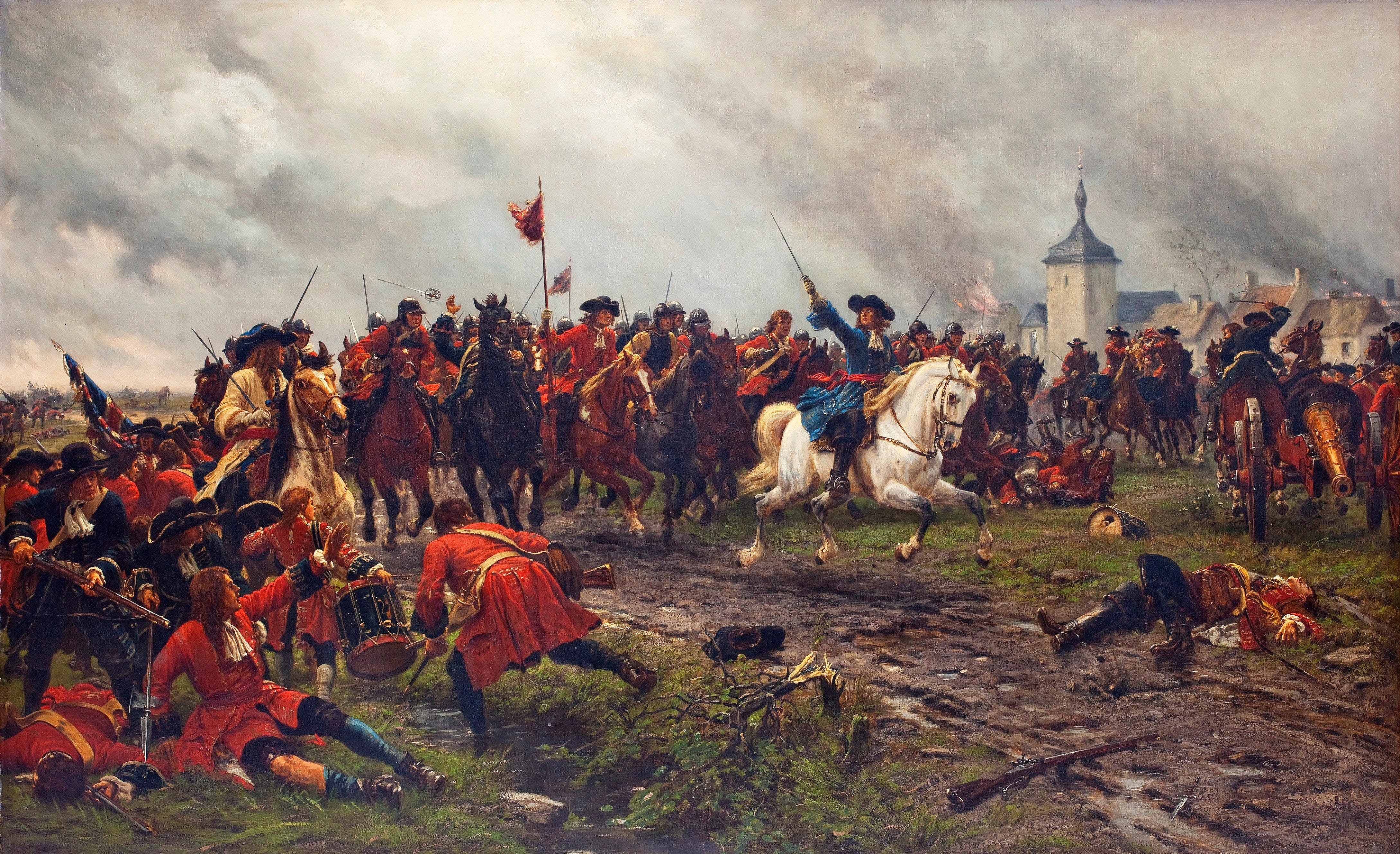
Those familiar with Napoleonic warfare will also note a doctrinal reliance in this period on infantry firepower. Discussions among war theorists in the early modern period raged back and forth over the preference for “fire”—that is, reliance on the firepower of disciplined massed musketry at medium or close range—versus “shock,” meaning large-scale attacks by point of bayonet (or, prior to 1700, the dreaded “push of pike”). Both had their advocates, their benefits, and their drawbacks. A preference for shock was strong on European battlefields from the 1790s to the 1810s and beyond; this led to many famous and dramatic attacks and charges by bayonet.3 But in the first half of the 18th century, fire ruled the battlefields of Europe, thanks in part to the abandonment of the pike and the increase in lethality of musketry. The bayonet would generally only be relied on to break an already psychologically broken foe, or to fight off a sudden cavalry attack. As the old general the Marquis de Puységur said in the 1740s, already several decades late, “Firearms, and not cold steel, now decide battles.” A military theorist in his final years, he was a participant at Malplaquet and a veteran of the wars of Louis XIV, and thus spoke with extensive experience. Fire was to dominate European battlefields for the next century.
Cavalry
Between the first and last year of the 18th century, the cavalry was perhaps the least-changed arm of the army. The light horse—hussars, chasseurs (French for “hunters”), and chevaux-légeres (literally “light horse”)—conducted reconnaissance for an army and screened its movements; at night its videttes established a protective perimeter around the encampment, giving early warning to enemy movements or surprise attacks; in battle they would be frenetic in their movements, charging and reforming and charging again alongside the advance and musket volleys of the infantry. The heavy cavalry, primarily cuirassiers (named so for their steel breastplates, or “cuirasses”) but also sometimes dragoons, could deliver the coup de grâce with a massed charge as the enemy wavered. Cavalry could attack with sword and lance, and light cavalry often carried pairs (sometimes several pairs) of pistols for close action against their mounted opponents.
Cavalry, as later, was organized at the highest permanent level into regiments, and then divided into three or four squadrons for tactical flexibility, each with a campaign strength4 of 100 to 150 men. Brigades usually comprised several regiments each (thus often between eight and 12 squadrons), and several brigades made up a division. These brigades and divisions, like in the infantry, were temporary and ad-hoc formations which would change at will, sometimes even on the eve of battle, as circumstances, terrain, and the plans of the commanding general required.
Perhaps the greatest change over the course of the century was the decline in reliance upon the cavalry, and the greater preponderance of infantry relative to the army size as a whole. In the Napoleonic Wars, cavalry generally made up about one-sixth of an army’s manpower. In the War of the Spanish Succession, they were between one-third and one-half. The continued improvement in infantry doctrine, training, and formations throughout the 1700s reduced the battlefield role of cavalry significantly. As populations grew, so did armies; and it was easier and quicker to train and equip an infantryman than a cavalryman, who required an expensive horse, which had to be acquired by the army and kept hale by good maintenance.
None of this is to say that cavalry fell out of fashion or failed to make great contributions in this era. As we shall see, battles could still be defined and even decided by confused and decisive clashes of cavalry. In spectacular fashion, the cavalry were to play a crucial role in the century’s bloodiest battle.
Sieges and campaigns
As Chandler points out, “Few periods of military history can have been more dominated by siege warfare than the 60-odd years between 1680 and 1748.” In the 60 years prior to 1680, there was one siege in Europe for every 3.5 field battles; in the 66 years after 1748 (until 1815), there were two field battles for every siege. Yet for the aforementioned period straddling the dawn of the 18th century, there was one field battle for every 1.16 sieges. During the War of the Austrian Succession (1740–48), the French army, under the overall leadership of Marshal de Saxe, conducted no fewer than 84 sieges in Belgium. Even the Duke of Marlborough, renowned for his incredible performance as a battlefield commander, only fought four major battles. By contrast, he commanded in 30 sieges.
The preponderance of siege warfare in this age can be credited to the rise of military engineering as a precise science; and of all the engineers of the era, the Marquis de Vauban towers above all the rest. It is not hyperbole to say that he was the greatest and most influential engineer in military history, and, for that matter, one of the most influential engineers in all history. His work was not limited to warfare, as he contributed also to the design and expansion of port facilities. Contrary to popular belief, he did not invent the concept of the star fort (so named for its design which, when viewed from above, resembles a many-pointed star to help in deflecting cannon shots and creating musket killzones from the walls), but in essence perfected its design with elaborate and well-planned methods to perfect their killing power and strength of resistance. And then, after he had overseen the construction of many forts during Louis’ reign, he began to perfect the method by which these very forts could be encircled, besieged, and taken. The only serious contemporary to challenge his status was the Dutchman Menno van Coehoorn, whom he had faced off against at Namur in 1692; the two died almost exactly three years apart in the final years of Louis’ reign. A not-insignificant portion of the credit for France’s military dominance in the late 17th century is owed to Vauban, and King Louis knew it. “Nobody can have more consideration, esteem, or friendship,” he wrote to Vauban in 1693, “than I have for you.” For his invaluable services, Vauban was made a marshal in 1703, just a few years before his death at 73.
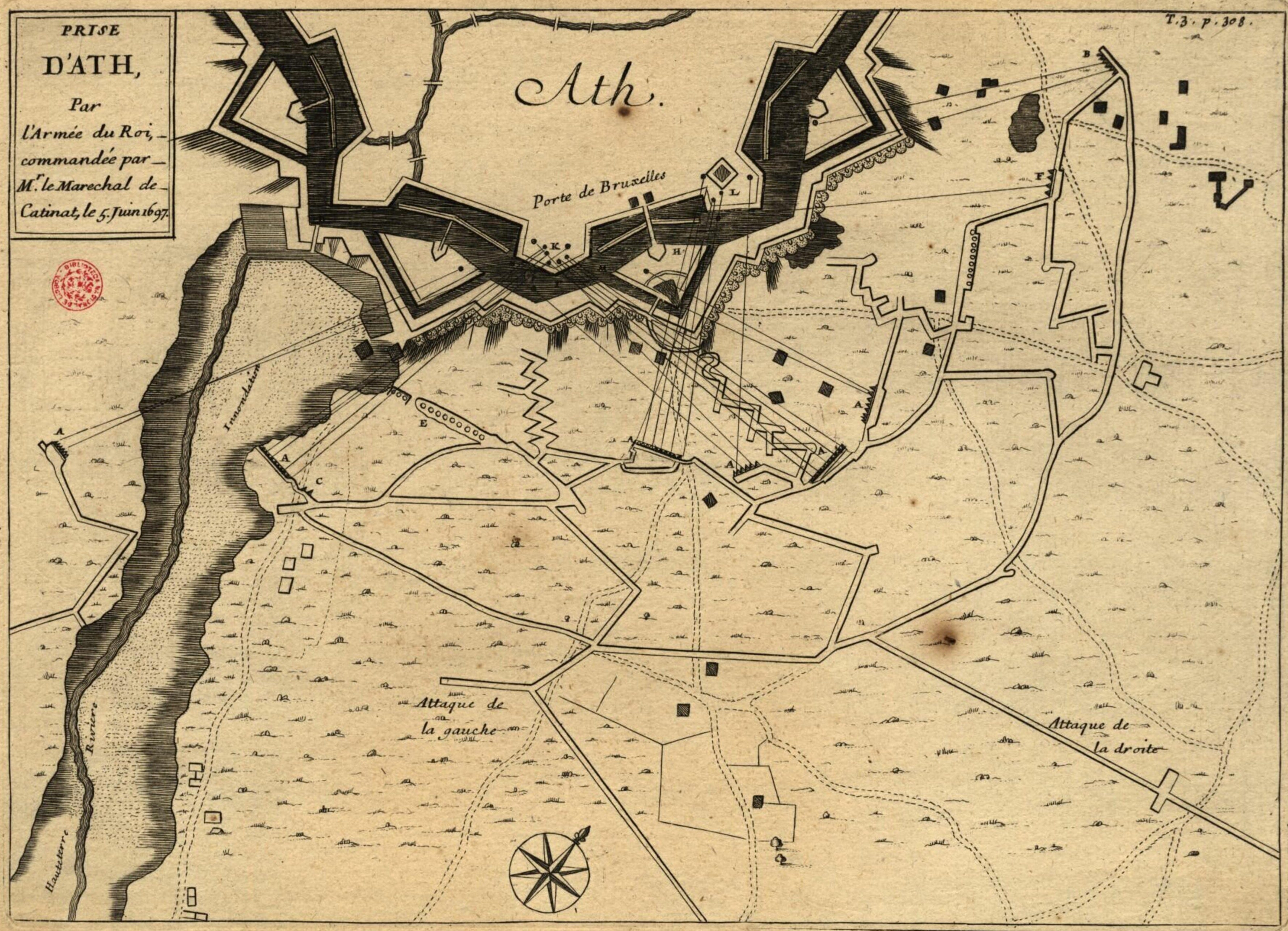
Vauban’s perfection of the art of besieging star forts helped to turn them from serious roadblocks into more or less a nuisance; something that often had to be dealt with, but something which could be neutralized systematically and fairly quickly. While one force besieged and reduced a fort, an “army of observation” could be posted nearby to protect the besieging army, discover the approach of armies of relief, and bring them to battle before they could attempt to lift the siege. Despite the trivialization of fortresses, they still remained imposing obstacles well into the 19th century. In the last decades of Louis XIV’s rule, they could still be used to dominate important highways and protect wealthy port cities. In peacetime, they had the added value of projecting state power into regions which could be politically troublesome—like Belgium, ruled from Habsburg Madrid over 700 miles away. Vauban’s time as Louis’ premiere military engineer resulted in the construction of numerous powerful forts on the northern French frontier and stretching into Belgium.
Fortresses were often supplemented with the construction of vast defensive lines—what strategists of the 20th century would term “defensive” or “fortified belts”—which could extend for dozens of miles along the lengths of rivers and canals. Outposts, earthen redoubts, and breastworks could be built which, if manned, would pose a formidable obstacle to invading armies. The French especially would utilize many such lines in the final decades of the 17th century, and in particular in Belgium. Their use played a key role in the events of the War of the Spanish Succession.
These defensive belts became practical as the size of armies grew over the course of the century. They became a serious asset as states in Europe began to grapple with the logistical difficulties of clothing, feeding, arming, and paying these increasingly-large armies in the field for extended periods. (One of the most complicated and intensive processes was providing armies with sufficient flour and grain, as well as the requisite ovens to bake them into bread; as well as the carts, wagons, oxen, mules, and horses necessary to move them all, in addition to all other supplies, from the heartland to the campaigning armies, sometimes hundreds of miles away.)
The food requirements of horses and other beasts of burden were an additional enormous strain on logistics and state finances, and arguably the biggest constraint on an army’s ability to operate. If an army decided to “cut loose” from its supply train and forage from the surrounding region—making “war feed war,” as the saying went, by essentially stealing from local civilians—then it could only really be done in the summer and part of the spring and autumn, when not only temperatures and weather were more or less tolerable, but also when there was sufficient grass upon which horses and mules could graze. To ease the financial burden that was paying soldiers’ salaries, “contributions” were often exacted from cities and entire regions, with the implication that the payments would also buy the soldiers’ good behavior and prevent future plundering.
John Lynn, an expert on early modern (1500–1800) warfare, succinctly describes the effect these factors would have on the military campaign as it existed at the dawn of the 18th century:
The predominance of positional warfare tended to limit decisive operations. Fortresses [and defensive belts] hampered a victorious army’s ability to follow up success on the battlefield. Forces bested on the battlefield could flee to friendly fortifications, making it harder to bag up defeated units with a vigorous pursuit. In fact, after battle, victors faced the frustrating possibility of simply running up against the walls of enemy fortresses which stood as barriers to continued advance. Armies that suffered serious casualties in battle could not only shelter behind fortifications but rebuild their numbers quickly by siphoning off troops from less vital garrisons, as William III did after the Battle of Seneffe. By obstructing a foe’s advance, fortresses also could buy time while reinforcements arrived from a less threatened front to buttress the one in greater danger.
In fact, Louis characteristically fought his wars on multiple fronts, which further hampered decisive operations. In contrast to Louis’ campaigns, Napoleon’s later success in his great campaigns of 1805–9 required the ability to concentrate the vast majority of his army against a single foe on a single front along a single line of operations.
While his characterization of Napoleon’s strategic operations is oversimplified and generalized, it is broadly correct. Louis’ sometimes problematic grand strategy aside, he was the greatest monarch of his age, and his legacy was to cast a great shadow over 18th and early 19th century Europe. He made frequent blunders in his warring, as Lynn elucidates, but it is in general a testament to his own talent as a statesmen, as well as the seemingly limitless pool of brilliant ministers and generals he relied upon, that France, often alone, and often faced by catastrophe, repeatedly weathered the storms of continental warfare. When Louis died in 1715, France, its financial difficulties and looming social instability notwithstanding, was by far the most powerful country in Europe.
Louis’ last war was in many ways the most important and, from a military perspective, the most spectacular. It was also without question the bloodiest. Thanks principally to the efforts of three generals, it would also mark the beginning of the end of the era of ponderous fortress-centered positional warfare. In that manner, it laid the groundwork for generals like Frederick the Great and, eventually, Napoleon to trailblaze across Europe and forever change the ways in which wars were fought.
Two Dukes and a Prince
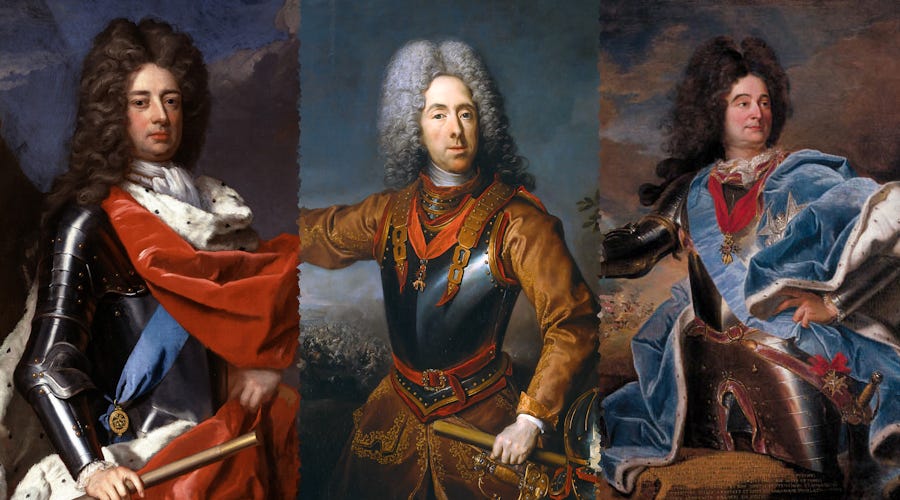
The Duke of Marlborough is not well known outside of Britain nor much beyond the circles of those acquainted, even superficially, with military history. In his day, though, he commanded the highest respect of European statesmen. Napoleon praised him not only as a talented soldier but a natural diplomat, able to deftly maneuver complicated European politics and make common cause with others. Wellington, when asked if he believed Napoleon or Marlborough the better general, admitted that it was “difficult to answer,” but settled on saying that “I can conceive nothing greater than Marlborough at the head of an English army.” Field Marshal Bernard Montgomery, Viscount of Alamein, called him a military genius, “capable […] of transcending the contemporary limitations of warfare.” In an age typified by ponderous movements and numerous sieges, Marlborough was aggressive, constantly seeking to bring the enemy to battle. When able, he conducted rigorous pursuits that would wreak further havoc on the enemy. It is easy to see why someone like Napoleon viewed him favorably; and even more interesting that generals like Wellington and Montgomery, usually typified more for prudence than aggression, also showered him with praise.
In 1722, a few years after his death, he was memorialized thusly on a victory column erected on his own estate:
the hero not only of his nation, but his age: whose glory was equal in the Council and in the Field: who by wisdom, justice, candour and address, reconciled various and even opposite interests, acquired an influence which no rank, no authority can give, nor any force but that of superior virtue, became the fixed, important centre, which united in one common cause, the principal states of Europe. Who by military knowledge, and irresistible valour, in a long series of uninterrupted triumphs, broke the power of France, when raised the highest, when exerted the most, rescued the Empire from desolation, asserted and confirmed the liberties of Europe …
Though he died in good favor, he spent much of the last decade of his life in ignominy. This was due in large part to the outcome of the campaign of 1709. But that summer, Marlborough was 59, with three decades of military experience behind him. He was at the height of his power: his reputation was at its apogee, and the general feeling in Europe was that it was only a matter of time before he and his multinational army (of British, Dutch, Prussian, Hessian, Austrian, Danish, and Hanoverian troops) would break Louis XIV’s will to resist the demands of the Grand Alliance. In fact, after Oudenarde in 1708, Louis did indeed sue for peace. But the Allies overplayed their hand; their terms were too harsh. The French hoped, but no one knew, that this was to be the high water mark of the Allied war effort. Their chance for a true victory slipped away.
Nevertheless, the Allies were riding on a serious high in the Spanish Netherlands. While the French had had successes elsewhere in 1708, their armies had encountered failure after failure in modern-day Belgium. What was worse was that Marlborough was now joined by an Imperial army under the command of Prince Eugene of Savoy, who was probably Europe’s second-best general.
Eugene, born in Paris in 1663, raised at Versailles, and Italian by ancestry, was a lifelong servant of the Habsburg emperors. By the beginning of the war in 1701, he was the most distinguished commander in the Holy Roman Empire, and was already recognized as one of the greatest generals of the age. At the age of 20 he fought during the famous Siege of Vienna. Throughout the rest of the Great Turkish War (1683–99) he fostered a powerful reputation, and won fame for his crushing 1697 victory over the Turks at Zenta. Eugene’s fame at the turn of the century was unmatched, but by 1709, he had been eclipsed by his English co-belligerent. Still, Marlborough was probably the only one to outshine him in his life. While Napoleon appreciated Marlborough, he considered Eugene one of the seven greatest generals ever. After an initial series of victories against French armies early in the war, Louis XIV wrote to his generals: “I have warned you that you are dealing with an enterprising young prince. He does not tie himself down to the rules of war.” In his youth, Eugene had sought a commission in the French army, the country of his birth; Louis had refused him.
Marlborough and Eugene were an unlikely combination of partners. The former was born essentially into the middle class; the latter lived an almost unparalleled life of prosperity and privilege from birth. Marlborough was considered ambitious; Eugene had no such aspirations. Perhaps most humorously, Marlborough was genteel, something which Eugene, always regarded as honest and even blunt to a fault, was never characterized as being. Yet, after fighting alongside one another at Blenheim and again at Oudenarde, Marlborough and Eugene not only mutually respected one another’s abilities, but had grown to become fast friends. The friendship came about from their similarities: like Marlborough, Eugene was aggressive, and preferred fighting in the field rather than laying siege to fortresses. He demanded much from his men, but his men responded positively because he shared in their tribulations and, like Marlborough, was exceptionally courageous.5 Both men found that they wished to prosecute the war in a more aggressive and practical manner than their political leaders, whom they often found themselves at odds with. In this way, their struggles were one and the same, and they could sympathize with the political plight of the other. In September 1709, Eugene was 45 years old.
The opponent of these two great Allied captains, in 1709, was the last of the great French marshals whose reputation, in this war, had not yet been sullied by terrible defeat. Born Claude Louis Hector de Villars, later the duc (duke) de Villars, like the two men who would become his opponents, was a soldier from his youth. He obtained a commission in Louis’ army and fought under the great Marshal Turenne in the Franco-Dutch War of the 1670s.6 From these early years Villars was noted for his brash and braggadocious behavior, but simultaneously was noted both for his ability and, even moreso, his fighting spirit and bravery. At the Siege of Maastricht in 1673, where Louis XIV himself directed siege operations, Villars led a small cavalry charge against orders. Afterward, he was ushered into the royal presence to be officially reprimanded. Villars boldly responded that the king clearly bestowed his favor on the French infantry; he merely wished to bring to the king’s attention the bravery and ability of the French cavalry. The reply astonished all in attendance. When Turenne officially mentioned him in dispatches for his exceptional and brave conduct, Louis wrote in the margins, “Like that of a young officer whom it is necessary to promote.” The behavior typified his entire career. At Maastricht, he was just 20 years old. It was in this manner, by overstating his own achievements, that he received his marshal’s baton in 1702 after a “victory,” really more of a stalemate, at Friedlingen.
Though a noble, he was a petty noble by birth, and it is probably not a stretch to say that he had some sort of a metaphorical chip on his shoulder. His ostentatious behavior was, needless to say, controversial, and remained so as his star ascended and he grew in rank and notoriety. Despite his polarizing behavior at court, he did enjoy the total and complete trust of the men who served under him. Like Marlborough and Eugene, he was courageous. He was also a skilled organizer and administrator, the result being that the men under his command tended to be better supplied and taken care of than those under other French marshals. He also had a very keen eye for talent, promoting those whom he believed would one day be skilled commanders, and loudly denigrating those whom he believed to have risen beyond their ability or whom he had judged were outright incompetent.7 Villars was just three years Marlborough’s junior, aged 56 at Malplaquet.
Marlborough is rightly regarded as one of the best generals to ever come out of the British Isles. Some consider him the greatest, and it is not a very difficult argument to make, as his record was one of consummate success combined with astute diplomatic and interpersonal skill. Eugene was also one of the towering figures of this period of military history, and probably the most talented and successful to ever serve the Habsburg dynasty. Yet, on the eve of what they believed was the beginning of the end of the war, they both found themselves very sorely tested on the freshly-ploughed fields outside the village of Malplaquet, on the very frontiers of France. Precisely the reason why Malplaquet is so interesting a battle is that all three senior commanders were all so different and yet so alike; and it is all the more interesting that two era-defining talents were, in some sense, bested by just one.
How Is It That We Do Not Have Even Boots and Bread?
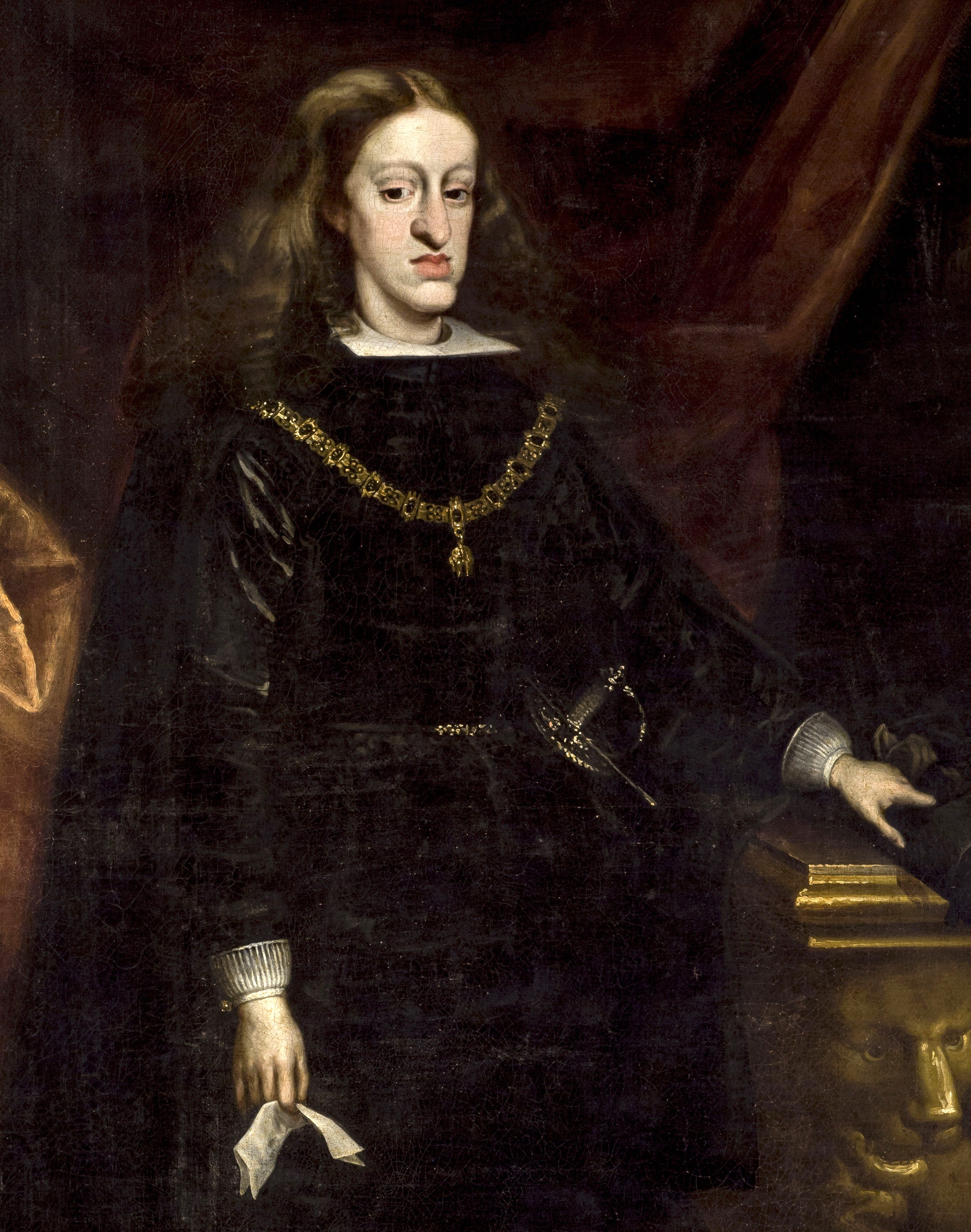
King Charles II of Spain, a Habsburg with numerous congenital illnesses, died childless at 38 in 1700. His father, Philip IV (1605–65), had stipulated in his own will that the line should pass, under such circumstances, to the Austrian branch of the Habsburg dynasty. Holy Roman Emperor Leopold I (Charles’ cousin and brother-in-law) decreed as much when news of Charles’ death reached him. Yet Charles had designated Philippe d’Anjou as his heir. It was a calculated move to preserve Spanish imperial hegemony without entangling it in foreign alliances, and Charles, after all, wanted the future Spanish monarch to be determined by him, rather than his later father or the court of Vienna. Additionally, Charles’ health had been failing for an extended period, and in these waning years of his life, the Spanish court exerted additional influence to secure the nomination of Philippe as heir. But there was a significant problem: Philippe was not a Habsburg, but a Bourbon, and, worse yet, a grandson of Louis XIV (his father was Louis’ eldest son and heir, who ultimately predeceased the French king in 1711). All of Europe feared that a Bourbon on the throne of both countries would result in a continent-dominating alliance of the world’s two greatest imperial powers. Charles had expressly condemned any move to unite the countries under one crown, but once the ball started rolling, Louis continued to push it along. War between France and Austria became inevitable, and other countries, including England and the Netherlands, also intervened to prevent the throne from passing to Philippe. Thus formed the Grand Alliance, uniting nearly all of Western and Central Europe against France and Spain, the latter of which fractured into pro- and anti-Bourbon camps.
The Allied armies therefore were an army of many nations and languages. English, Scottish, Dutch, north and south German (including Prussian, Austrian, and Swiss), Danish, and Hungarian troops were all present in the Allied ranks at Malplaquet; not to mention troops also from non-independent regions, like Flanders, Wallonia, Italy, Ireland, and Croatia.
In 1709 France stood on the precipice of disaster. Her armies were in retreat, defeated at every turn. The war in northern Italy had already been prematurely ended with a local armistice in 1707. Skilled French marshals in the Spanish Netherlands had been beaten in resounding fashion, first at Ramillies and again at Oudenarde. (Such was the scale of his defeat that, after his defeat at Ramillies in 1704 and subsequent removal from command, the duc de Villeroy, Louis’ favorite, lamented, “I cannot foresee a happy day in my life save only that of my death.”) Most of Vauban’s vaunted fortresses in Belgium had been captured in the first few years of the war, bringing the devastation of war and pillage closer to French soil.
But it had not all been bad; the disasters of 1706 in Italy and Flanders gave way to success on the Rhine. There, Villars pierced the Allied defensive line along the Rhine by way of a clever ruse de guerre, and exacted monetary contributions from several of France’s enemies. He captured the defensive line and most of its artillery while having lost no casualties in combat, turning his enemies out of their works without a shot fired. This spectacular success, though lacking in glory, ended up being France’s greatest victory of 1707. Villars spent 1708 consolidating his gains on the Rhine, but when Marshal Vendôme encountered disaster at Oudenarde, the country once more entered a period of crisis. Panic gripped Versailles as fears grew that the Allies would march on Paris.
Vendôme was no pushover; though Louis took to him slowly, he was recognized as a talented general who had won several major victories in Italy before that theater turned sour. After Oudenarde and the subsequent surrender of the fortress of Lille, Louis appointed Marshal Boufflers, the seniormost (by age and rank) of all the French marshals, to assume command of the battered Armée de Flandre (“Army of Flanders”). He had been in command of the army at the outset of the war, but was relieved in 1703 for uninspiring conduct. Yet now his failure to perform paled in comparison to the disasters of Ramillies and Oudenarde, and he was restored to command. When Boufflers arrived in the army encampment in the winter of 1708–9, he struggled to manage the gargantuan task before him. The army was dejected, poorly-supplied, and on the brink of collapse. Even members of Louis’ court recognized the admirable but futile efforts of the old marshal to restore the army to health: one of Louis’ mistresses remarked, “the maréchal de Boufflers works as much by himself as all of our ministers together. He tries to untangle the horrible mess into which our generals have let the army fall.” His age (he was 65), the weather, and the seemingly insurmountable task itself ran down his health, and in March 1709 he resigned so that he could recuperate in Paris.
The result was that there was only one marshal remaining who would be politically tolerable to assume command of the never-victorious Army of Flanders.8 Louis had refused to give Villars command in 1708, despite his success on the Rhine the previous year—he still knew Villars to be rash and aggressive with his own independent streak, which the king feared. But the truth of the matter was that there was no one left available. Like Vendôme before Oudenarde, he had a record of success. But perhaps it would be Villars’ “my way or the highway” attitude, and his own popularity with the troops, which was just what the army needed. Nevertheless, it was not an easy decision for Louis. The king was growing increasingly desperate, and the Allied refusal of his peace terms had stung deeply. There was one hope left: that the French army could halt Marlborough’s advance and prevent an invasion of France itself. Villars was the last and, now, only choice.
Upon assuming command of the army in March, Villars was aghast at its poor condition. Pay was in arrears by months, there was little food or supply to be had, and the magazines were empty of spare uniforms and equipment. Perhaps worst of all, as a consequence of all of these things and the numerous defeats the army had suffered, morale was at rock bottom. The starvation conditions caused by the recent harsh winter (the “Great Winter” in French historiography, and the “Great Frost” in the British Isles) and bad harvest exacerbated the food crisis. So serious was the situation that Villars rode overnight to the war minister’s residence in Marly near Paris, arriving early in the morning and shouting in his face as he woke from bed, “You are the war minister. Do you not realize that you are exposing yourself to horrible reproaches if you do not supply me? How is it that we do not have even boots and bread—that our weapons are unserviceable?” Three days later he repeated these qualms, in his typical brusque manner, in the presence of the king. Louis agreed to do improve the situation of Villars’ army and said, “All I have left is my confidence in God and you, my outspoken friend.”
Despite these royal statements, the promised food never arrived. Desperate, and not willing to wait any longer, Villars ordered his own cavalry to raid through parts of northeastern France, foraging as they went, to provide enough food for the army to prevent its destruction by starvation. Louis’ mistress, previously writing sympathetically of Boufflers, now wrote glowingly of Villars: “We finally have a general who has faith in the soldier, in the fate of France, and in himself.”
By the time campaign weather returned in the late spring, Villars had worked his magic and restored the army to a mostly hale condition. While the army was still not victorious, his ability to improve the supply situation (sometimes by theft from the local population), and his own personal charisma, had restored the army’s hopes of success. Despite years of constant failure, which Marlborough and Eugene were soon to take for granted, it was a very formidable force. His army comprised 120 infantry battalions, approximately 260 cavalry squadrons, and 80 pieces of artillery. All told he had probably close to 90,000 men, composed of 26 or 28,000 cavalry, 55 to 60,000 infantry, and several thousand artillerists (including those manning the battalion guns serving with the infantry). Serving alongside the nearly entirely French army were a series of German mercenary regiments, as well as the aforementioned famed Irish Brigade of five battalions, or approximately 2500 men. Most of Villars’ infantry battalions were seriously understrength; his army was weaker than the number of units implied. Despite this, Villars’ achievement was significant, and is reflective of France’s own dogged resilience in the war. As Voltaire wrote many decades later, “[…] it is no easy task to stand against half of Europe after losing five major battles and surviving the terrible winter of 1709.”9
In early September, on the eve of battle, Boufflers, mostly recovered from his previous illness, requested permission from Villars to join the army. Villars, recognizing Boufflers’ seniority, offered to relinquish command. Yet Boufflers did not seek army command: he was willing to forgo his seniority and fight under Villars as a matter of duty. He wrote to Villars: “Be sure that it is with the greatest joy that I could have, and this [joy] will always be to receive your orders. You are more worthy, by all reason, to give them.” Villars made Boufflers his second-in-command, and at Malplaquet he commanded one half of the French army.
Entering 1709, the Allied armies in Flanders were in justifiably high spirits. Two talented French marshals had been soundly beaten by Marlborough and his polyglot army, and in December 1708 the proud fortress city of Lille, commanded by Boufflers,10 surrendered after four months of siege which had exacted significant casualties on both sides. To make matters politically worse, Lille was a French city, rather than Walloon; its loss was heralded by both sides as the beginning of the end of French resistance in the war.
Despite their growing overconfidence and belief in the inevitability of French defeat, the Allied commanders, Marlborough and Eugene, did not believe setbacks were no longer a possibility. The army entered winter quarters at Ghent, between Brussels and Bruges (having left a garrison to defend the newly-taken Lille), and spent the winter devising a plan for the 1709 campaign. Initially they considered a march along the coast, bypassing Villars’ army and relying on the support of the dominant Royal Navy. But to do so would leave themselves exposed to a flanking attack—they knew Villars was aggressive, and guessed he would not let the Allies put boot to French soil without a fight. To march along the coast was also to court disaster; with their backs to the sea, they would not be able to embark their army aboard British ships in a timely fashion. So they discarded the idea of a coastal advance.
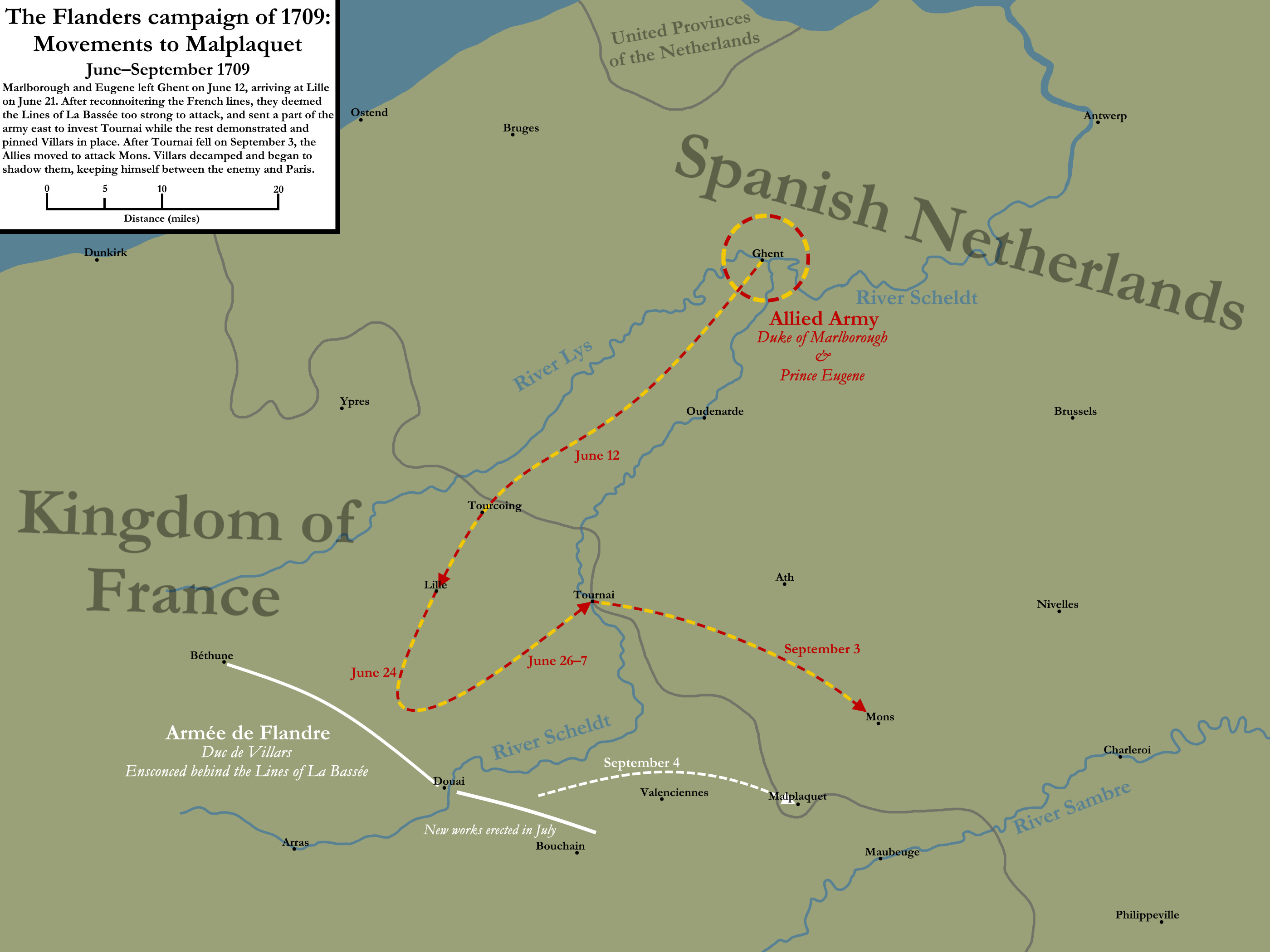
Villars, when not rectifying the troubling issue of his supplies, had spent the intervening months constructing a new defensive line that stretched from Béthune, in the west, eastward toward Douai, in a line that traced itself generally southeastwards for a length of about 25 miles. This line of earthworks became known as the Lines of La Bassée, named for the village that was near the apex of its concavity, and which served as Villars’ headquarters.
Lille remained in enemy hands, but the fortress city of Tournai, along the River Scheldt and straddling the Franco-Flemish border, was a thorn in the side of the Allies. Ypres, further to the northwest, was also a formidable obstacle. It was Villars’ hope that these two fortresses could stymie the Allied advance and forestall an invasion of France itself throughout the 1709 campaigning season. If he could succeed in this, he could, with the additional time purchased by the resistance of the forts, further strengthen his army for a vigorous campaign in 1710. It was unlike Villars to be so passive, but he had no choice. Louis also expressly forbid any offensive action against the Allied army. Such was Villars’ adaptability as a commander that he forwent his preference for attack without complaint, and instead chose to bide his time and rebuild his battered army. Even in this early stage, he was vindicating Louis’ reluctant decision to appoint him to command.
Marlborough and Eugene recognized the strength of Villars’ position, and instead of attacking him head on—as much as they both wished for it—they instead settled for the idea of a flanking attack against either Ypres or Tournai. If either fortress could be captured quickly, they could turn Villars out of his strong position, and then beat him decisively in open battle. Marlborough favored an attack on Ypres, but Eugene and the Count of Tilly,11 commander of Dutch forces, favored Tournai; so there the army went.
The Allied army in mid-1709 was in excellent condition. Honed by years of successful campaigning, brimming with confidence, and led by the two best generals in the world, they were an impressive force to behold, and a fearsome army—one of the best of the age. The 1707 Acts of Union had joined together the crowns of England and Scotland, thereby producing a united “British” army from myriad English and Scottish regiments. The British made up a small portion of the forces in Flanders, however: just 19 battalions and 15 squadrons, or about 15,000 men in all. The great majority of troops in the Allied army were of German extraction, with an additional 17 battalions and around 50 squadrons of ethnic Dutch, for a grand total of another 15,000 men. (Many other so-called “Dutch” units were in fact German and Swiss mercenary companies and regiments in Dutch pay.) During the Nine Years War of the 1690s, the Dutch drew praise from the French and English alike for their incredible discipline and high morale. These qualities carried over into the first decade of the 18th century. They were an integral part of the alliance, and would play a critical role in the coming battle.
There were another 14 to 19 battalions (historical records are uncertain) of Prussians with about 20 squadrons accompanying, for maybe 12,000 men; about 5000 Danes, including a battalion of the elite Foot Guards; and a smattering of units from across the Holy Roman Empire, representing states like Holstein-Gottorp, Münster, Hesse-Kassel, Württemberg, and Saxony. Of course, there were Austrians also—four battalions’ worth, a small share of the Empire’s contributions. All told, Marlborough’s and Eugene’s army probably had about 70,000 infantry, nearly or approximately 30,000 cavalry, and 101 heavy guns, for a total of 100- to 105,000 men,12 organized into about 129 battalions and 253 squadrons. Their manpower advantage over Villars was that of 1.14 to 1.
The Most Shameful Thing in the World: The Siege of Tournai, June 28–September 3
Villars believed he would be able to maintain his position as an “army in being” against the enemy. If they chose to invest either Ypres or Tournai, they would leave themselves exposed to an attack by his army to relieve the city. Whether he would actually execute such an attack was not fully decided, but the threat of it, he hoped, would keep the Allies off-balance and hesitant to conduct offensive operations against the forts. Instead, knowing Marlborough and Eugene as he did, he expected them to seek out battle with his army. Once the French were defeated, they could then turn their attention to reducing Tournai and Ypres, while the main body of the army continued into France itself. This explains the effort Villars dedicated toward the creation of the lines at La Bassée. And if the Allies refused to attack his well-entrenched and rejuvenated army, all the better. What Villars needed was time.
Indeed, at the start Marlborough and Eugene countenanced an immediate advance to bring Villars to battle and defeat him. Advancing from Ghent on June 12, they arrived at Lille, their area of forward operations, on June 21. Scouting reports went out over the following days, revealing for the first time the extent of Villars’ preparations and the strength of his works. Marlborough and Eugene briefly dithered, then devised a new plan: the main body would feint on Villars’ front, pretending to prepare to attack and keeping him pinned in place, while a portion of the army moved east to invest Tournai. If the city could be reduced quickly enough, the French would not have time to respond, and there would still be plenty of weeks of good campaigning weather left. On June 24 the army moved forward. Villars, apparently finally confirmed in his suspicion of the enemy’s wish to attack his army in situ, withdrew additional troops from the Tournai garrison to strengthen his forces. It was not until he realized on June 26 that he had been fooled. Dutch troops under Tilly moved northeast and encircled the city on June 27, with the rest of the Allied army following over the next few days.
The seriously reduced Tournai garrison was still a respectable 7000 men, but the city was ill-provisioned for an extensive siege. Villars’ army was not ready for offensive operations and thus could not realistically move to aid the city; the French marshal’s bluff had been called. The defenders mounted a very spirited defense with numerous successful sally attempts, but eventually the fortress surrendered on July 30, and the citadel, at the heart of the city, capitulated on September 3.
Villars was furious: “If this citadel had been supplied as ordered, certainly, without being committed to a battle, we would have reached the end of September and presumably the end of the campaign. […] [it is] the most shameful thing in the world.” The harsh winter, poor harvest, and apparent failures of the French state had apparently doomed his whole plan of campaign. His demands for the fort to be properly supplied were unrealistic; he could barely feed his own army, nevermind the fortress garrisons. Yet it was not all unbloodied glory for the Allies: they had suffered 5000 casualties in repeated attempts to storm the fortress, as well as from disease. Villars, meanwhile, had extended his defensive works further eastward, protecting the city of Valenciennes and covering the roads directly from Tournai into the French interior.
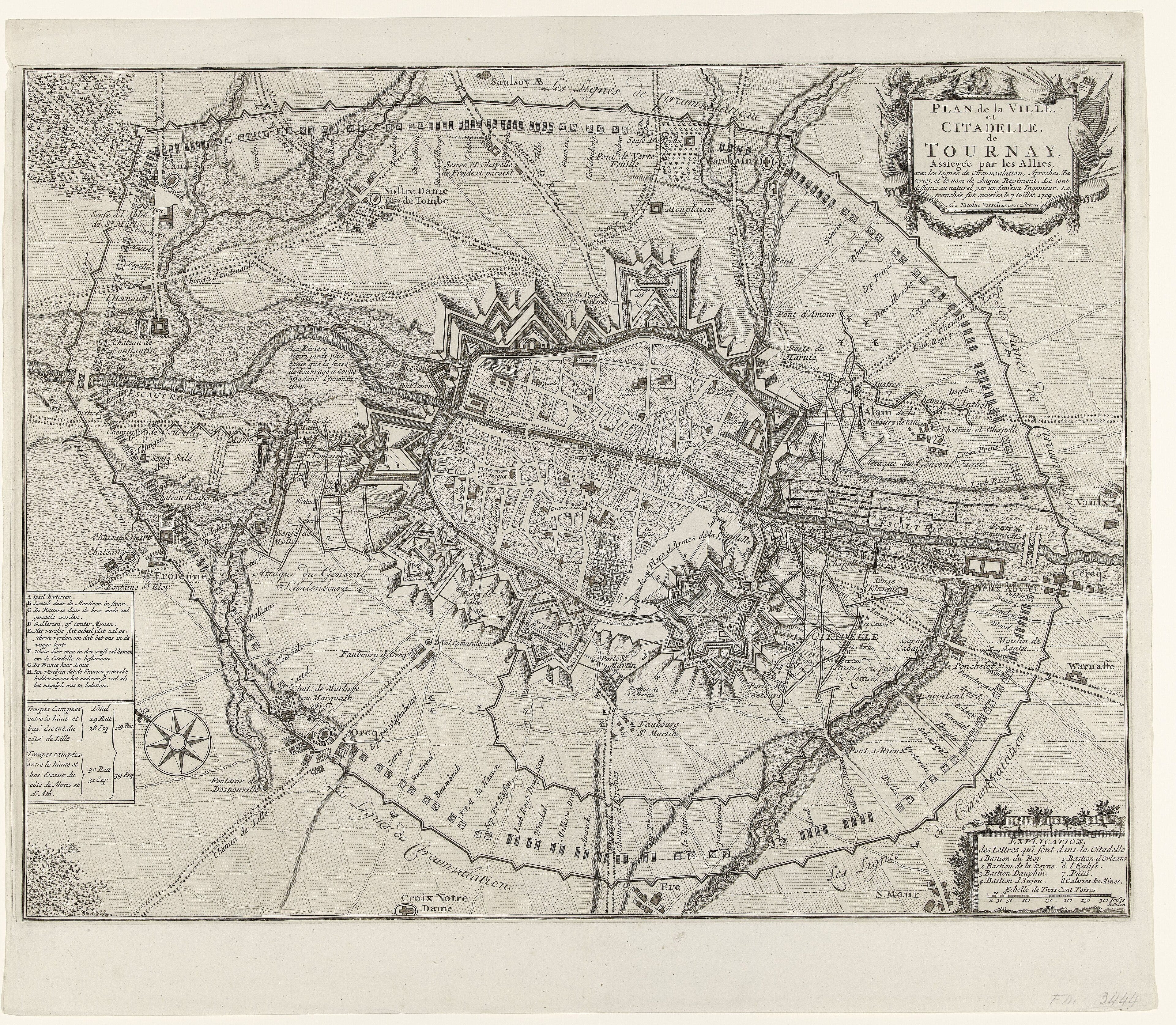
The fall of Tournai sent a bolt of panic through the court at Versailles. Louis wrote Villars: “Should Mons follow the fate of Tournai, our case is undone. You are by every means in your power to relieve the garrison. The cost is not to be considered. The salvation of France is at stake.” Louis’ fear in these words is almost palpable. Villars had now been given a blank cheque to do whatever he believed necessary to save France from imminent invasion. The hard-fighting marshal was no doubt pleased, despite his own anxieties over what was to come. “The citadel of Tournai[,] once gone,” he had said prior to the city’s fall, “I do not [in that case] hope long to avoid a fight.” He would now get it, and he was compelled to prevent a siege of Mons—or, barring that, to attack and break the siege once it had begun.
The campaign had now developed into September—there was little time left for good weather, but Marlborough and Eugene wanted to get one last punch in before the weather turned. Believing Villars would still not hazard his army as he had failed to do for Tournai, the Allied army moved again for Mons, further to the east. In so doing they hoped not only to deal another blow to the French army, but to turn Villars out of his defensive works, or otherwise stretch his line so much that it could be broken with a concentrated, decisive attack at a single point.
Villars detected this new Allied threat, sent a small detachment of a few hundred men ahead to reinforce the city’s garrison, and then had his army decamp on September 4 and move toward Maubeuge, shadowing the Allied army as it went east. The opportunity presented to possibly attack Marlborough’s columns on the road (Eugene’s forces were a few miles distant), but Villars did not wish to hazard such an enterprise: he had a healthy respect for Eugene, and worried the Italian prince would come down on his right flank and roll his army up while the French were busy trying to beat Marlborough. Villars instead decided to concentrate his army in front of the village of Malplaquet, several miles northwest of Maubeuge, sitting on the road that led from Mons directly into the French interior.
There has been much discussion over the centuries asking, and attempting to explain, why Villars failed to attack Marlborough’s isolated column. Villars himself was criticized in the few days afterward by several officers in the army, particularly by the Chevalier des Bournays (Bouffler’s aide) and the Chevalier de Folard, both of whom believed that Villars’ decision not to attack was not only a huge mistake, but a sign of incompetence: “We did not profit from the most beautiful opportunity in the world to attack them in their march and in detail,” said the latter. “If one had attacked them on the 9th, the day that they arrived, there would have been no more question about their army.”
To be certain, however, as previously mentioned, Eugene was still close at hand. No doubt Villars, usually so willing and ready to attack, to march, and to out-maneuver the enemy, kept in mind Louis’ own apparent fear in his last several letters. In various letters to Villars during the siege of Tournai, he expressly forbid that France’s last army advance and give battle to the enemy. Villars’ smaller army was all that remained between the Allies and victory; between France and defeat, and, quite possibly, its despoilation, and the end of the Bourbon dynasty, or at least of Louis’ reign. The Army of Flanders had been nurtured back to a degree of health since the winter, but, on paper, was still no match for the Allied army in a stand-up fight. Most of its battalions were understrength, and food remained a chronic problem. Villars instead reasoned that he would force the enemy to fight on his own terms, on ground he had chosen, and dare them to storm an impressive series of defensive earthworks, built late on the 10th and throughout the following night, supported by the cream of the French army.
Marlborough and Eugene have also been subjected to criticisms levied over an apparent unwillingness to attack Villars while he gathered his army at Malplaquet on the 10th. The Allies began their own concentration that day, and much of the army was in position by early afternoon, but the artillery train had still largely not arrived, and would not be in position until shortly before sunset. Marlborough and Eugene enjoyed significant numerical superiority in infantry, and slight superiority in cavalry, but the two commanders had not jointly reconnoitered the ground (as they typically did), and even Eugene admitted, “Since we do not know the ground we dare not take any risks. The terrain is very uneven.” A massed Allied attack in fading light very possibly could have routed Villars’ army, which was still in the process of digging in. But they could not possibly have known this; any success could not be capitalized on in the pursuit, due to limited daylight; and in any case, attacking without the support of the army artillery train was a significant risk and a serious departure from doctrine at the time. Thus, to criticize the Allies for “inaction” on September 10 is unfair, made only with the benefit of perfect hindsight, just as it is to criticize Villars for “inaction” on the 9th. Even then, an Allied victory under such circumstances was likely, but still not certain.
Attack in the Name of God: The Battle of Malplaquet, September 11
On the evening of the 10th, Eugene issued a circular to those commanders answering directly to him. “Orders to attack the enemy tomorrow in the name of God,” he invoked at its start. “My Lord Duke of Marlborough’s armies, the Imperial troops, and the corps13 from Tournai, which is to make a special attack, are to be let loose upon the enemy.” The Allies were undaunted by Villars’ numerous preparations: an all-out attack was to be made. “All attacks to begin at daybreak; the signal will be a salvo from the entire British artillery, which will be taken up [joined] by the Dutch cannon.”
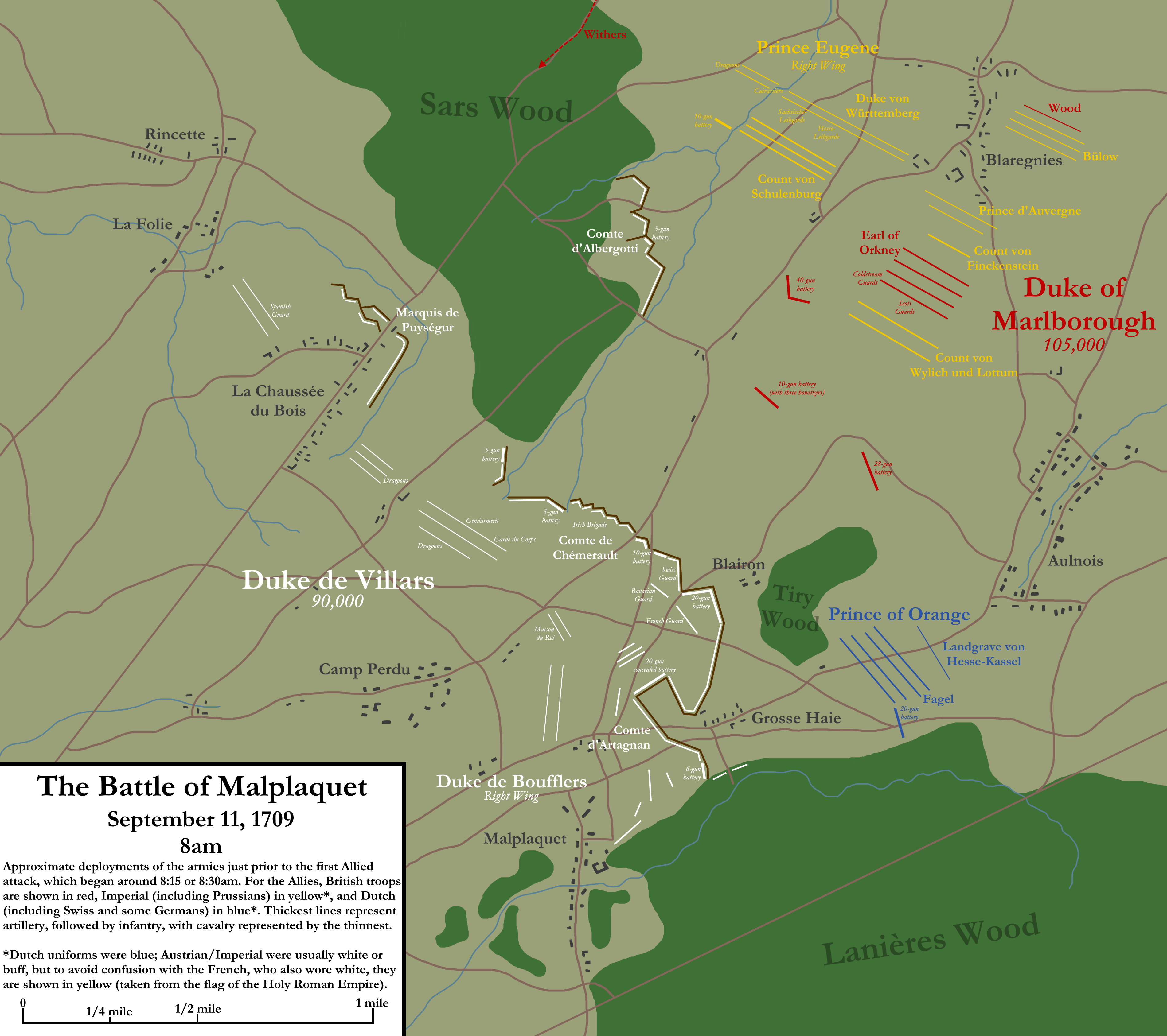
Full of confidence though they were, Marlborough and Eugene no doubt knew it would be a hard fight. Indeed, their task was to be the most difficult yet put before either of them in the war. Villars had chosen his ground well. A series of redans, large V-shaped earthworks or redoubts with ditches in their front, had been built to assist in the positioning of the artillery and to anchor defensive strongpoints. Villars diverged from the typical deployment of the period. Instead of spreading his guns out along the line, he grouped his artillery in a series of larger batteries at key positions, permitting him to mass his defensive firepower where he believed they would be needed most. Accounts differ, but Villars probably had eight or nine larger redans, plus numerous smaller redoubts, all connected by an interweaving series of earthen breastworks that extended the entire length of the French line.
What made Villars’ choosing of the ground so impressive was that the Allies would, at least by convention, be forced to attack down the center against prepared and well-sited positions, hemmed in on both flanks by large forests.14 On the Allied left (in the east) was the Lanières Wood (Bois de Lanières), while on their right was the Sars Wood. In the center essentially dividing the open ground into two (and thus the Allied avenues of attack) was the smaller Tiry Wood. Villars placed several battalions on his right, at the edge of the Lanières Wood, while his left was held in strength by about 20 battalions, deployed at the treeline of the Sars Wood, and just forward of it, with both earthworks and a battery of five guns. Additional infantry were behind the Sars Wood as a second line, with their own entrenchments. The French cavalry were deployed in two lines along the entire length of the French deployment, ready to support the infantry if the Allies made a breakthrough anywhere.
Marshal Boufflers, returned from his recuperation in Paris, commanded the French right, encompassing the troops in and near the Lanières Wood, under the brave and energetic 69 year-old Comte d’Artagnan. Among the latter were placed the four battalions of the French Guard, officially the bodyguard of the royal household and ostensibly the elite of the French army, along with two supplementary battalions of equally renowned Swiss Guard. Boufflers had at his disposal almost half of the French infantry.
The French extreme left, at the edge of the Sars Wood, was held by the Comte d’Albergotti, an ethnic Italian who achieved rapid promotion earlier in the war and was described by Villars as “very brave, and [one] whom I esteemed.” Behind d’Albergotti and the Sars Wood was a small reserve of infantry, again in entrenchments, under the Marquis de Puységur. Villars broadly commanded the center and left, but delegated the open ground of the center and center-left, between Albertgotti and Boufflers, to the Comte de Chémerault, whose force included the Irish and Bavarian brigades of four battalions each, as well as several other German regiments.
The most clever and unorthodox aspect of Villars’ deployment was the creation of a concealed battery of 20 guns, placed in a redoubt, whose position was covered both by the nearby village of Gross Haie, and by a sharp turn in the French entrenchments, which doubled back westward before turning east again toward the Lanières Wood. The effect was to create a “weakness” in the French line that did not actually exist, inviting the Allied left into a killing zone covered on three sides by entrenched infantry and artillery. The deployment of infantry and artillery within the woods on both flanks also ensured that the entire approach to the French center could be completely hammered by devastating enfilading fire. The effect of the hidden battery was enhanced by a gentle rise in the ground to the battery’s front-left, meaning that part of the French infantry, on the battery’s right, was also obscured from the Allies’ view.
The existence of the woods of Sars and Lanières severely restricted both Marlborough’s and Eugene’s ability to understand the French position. Villars’ works were erected in plain sight of the enemy. Perhaps, they thought, Villars was not the impressive military mind they had first thought. At Blenheim and again at Ramillies, Allied forces under Marlborough had launched pinning attacks on the French flanks. When the French weakened their center to reinforce the flanks, Marlborough committed the main attack in the center, with spectacular results. Attacking through the forests of Sars and Lanières could be risky and bloody, but Marlborough had seen such attacks succeed before.15 If Villars could be compelled to weaken his center, a concerted attack there could overcome the benefit of the French earthworks. Such tactics had done wonders at Blenheim and Ramillies. Otherwise, the flanks, overtaken by powerful attacks, could emerge from the far side of the woods and wreak havoc in the rear of Villars’ center, effectively destroying his army.
The French use of earthworks in battle was relatively novel. Recognizing the strength of the defenses, the Allies also departed from the doctrine of the day by grouping their artillery together into several large batteries, mostly in the center and directed toward Villars’ fortifications.
The Allied right was given over to Eugene, which included about 40 battalions. These Imperial infantry, directly commanded by the Count von Schulenburg, would advance and attack d’Albergotti’s position at the edge of the Sars Wood, supported by 20 guns. On Eugene’s left was Marlborough’s center; part of this, 20 battalions of British and Prussian infantry under the Count von Wylich und Lottum (who fought at Blenheim and Oudenarde) and the Earl of Orkney in reserve (whose final attack won the day at Blenheim), would push forward, with another 40 guns in support, and then wheel right, headed westward, to attack d’Albergotti’s right flank. The reserve cavalry of Duke Karl Rudolf of Württemberg-Neuenstadt would be close at hand to support this entire effort. Marlborough held in further reserve more British and Prussian troops under the Count von Finckenstein, Dutch and German cavalry under the Prince d’Auvergne, and, in the extreme rear and ultimate reserve, about 70 squadrons of British and Prussian cavalry (approximately 8000 horsemen) under Lieutenant General Cornelius Wood and General von Bülow. Also arriving on the morning of the 11th from the recent siege of Tournai, having marched hard to the imminent battle, were an additional 19 Prussian and British battalions under General Henry Withers. Rather than have these tired men continue marching onto the Allied left, as envisioned—a time-consuming and fatiguing process—Marlborough ordered them to take the shorter route to join the attack on the Sars Wood, on Eugene’s right. This was the “corps from Tournai” Eugene mentioned in his memorandum to his generals.
The Allied left was under the nominal command of the Count of Tilly, but he chose to delegate authority of these troops—about half Dutch, half German—to the just-turned 22 year-old Johan Willem Friso, the German-born Dutch Prince of Orange. Thirty battalions were assigned to the task of advancing down the gap between the Lanières Wood and the Tiry Wood after the French left had been engaged by Eugene. Orange had distinguished himself with courage and determination at Oudenarde, playing a crucial role in the Allied victory there. That Orange would lead this attack was a further endorsement of his ability by both the respected Tilly and the master Marlborough, a decision which the Allied supreme commander, nevertheless, would probably (with only some justification) come to regret. The Dutch infantry were commanded by General François Fagel, and the cavalry by Landgrave (Count) Friedrich von Hesse-Kassel, later to reign by marriage as King of Sweden from 1720 to 1751.
When one sees the Allied deployment, the conclusion must be made that Marlborough and Eugene did not actually plan on enticing Villars into weakening his center; or at least, if they did, then the forces they kept in reserve were wholly inadequate to the task under normal circumstances. Rather, it becomes apparent that their preferred plan was to overwhelm Villars’ right, and especially his left, with incredibly powerful attacks that would then sweep across the French right, and through the Sars Wood on the French left. Villars reasoned that if the Allies (wisely) chose to avoid an all-out attack down the center, then their moves on the flanks would be complicated by the woods, which were notoriously bad ground for combat between close-order formations. The terrain would break up the attacking infantry and disorganize them. As always, Villars was playing for time.
On many battlefields, even generally “flat” terrain would have many subtle undulations which could be utilized to great effect. Malplaquet was no exception, and these small changes in the lay of the land would have devastating effect particularly on the Dutch, as they advanced, unknowingly, to within point-blank range of d’Artagnan’s concealed 20-gun battery on the right flank. But as with all battles, on the morning of September 11, the Allies, with all the confidence, momentum, and strength in their favor, were none the wiser.
The best infantry in the world
For now, however, the battlefield lay quiet, and wreathed in a dense fog that was slowly burned off by the rising sun. This fog began to clear sometime after 7 and probably close to 7:30am. Villars took this opportunity to ride forward with his staff. As he paraded in front of the French position, the French infantry and gunners behind their entrenchments pointed him out, and a great cry of “vive le maréchal!” went up along along the whole line.
At about 8 o’clock, Marlborough rode forward to the massed 40 guns just east of d’Albergotti’s entrenched troops, and gave the order for the signal salvo to be fired, as per Eugene’s instructions. Thus began Schulenburg’s advance toward the Sars Wood, probably at around 8:15, with Lottum on his left and Withers on his right.
Schulenburg, the closest to the target, immediately found himself facing incredibly fierce and disciplined fire. The French defenders waited until the Allies had closed to about 50 paces (approximately 40 yards, well within accurate musket range) before the first line of infantry was felled almost to a man. The Imperial infantry, rather than firing back, were busy attempting to dismantle several trees that had been cut down to slow the Allied advance. Schulenburg later explained,
We sent out small groups of men to dismantle these defenses and to encourage the enemy to give their first fire.16 They did not fire a single shot. […] As [we] approached the entrenchments, the enemy fired a volley and then retreated behind another entrenchment also protected by abatis [felled trees] of more than 80 paces wide. It was behind this entrenchment that the enemy put up their greatest resistance, with the sort of effective fire one would expect from the best infantry in the world.
Lottum’s complicated forward advance and right turn to hit d’Albergotti’s right flank, meanwhile, was complicated by unexpected marshy ground in their path, slowing the advance and leaving Schulenburg engaged, alone, for several minutes. d’Albergotti had sent small groups of infantry, platoons and half-platoons, to fire at the enemy among the abatis before withdrawing back to the main entrenchments. Lottum’s Imperial and British infantry, meanwhile, advanced in dense columns, 10 to 15 ranks deep, more than double their usual depth, in an attack reminiscent of the massed infantry assaults of the Napoleonic Wars. French musket- and artilleryfire wreaked havoc on the advancing Allied lines, particularly Schulenburg’s. It was not until 11am that they finally pushed d’Albergotti’s infantry back and made it to the edge of the Sars Wood itself.
Lottum’s advance, begun at 8:30, had, according to Schulenburg (perhaps both gratefully and enviously), begun “a little too early and even before the signal was given, which was why [Lottum’s] troops found it all the more easy to make themselves masters of the enemy entrenchments on their side.” D’Albergotti’s troops were too busy dealing with Schulenburg to offer a stout resistance against Lottum. A French officer serving under the Comte de Chémerault, in the French center, later described Lottum’s advance:
The fire of [our] battery was terrific and hardly a shot missed its mark. I could not help noticing the [Allied] officer in command who, although he seemed elderly, was nevertheless so active in giving his orders that there was no cessation of action anywhere. The cannon shot plunged into the enemy’s infantry and carried off whole ranks at a time, but a gap was no sooner created than it was immediately filled again, and they even continued their advance upon us without giving us any idea of the actual point of their attack. At last the column […] changed its direction a quarter right [headed westward] and threw itself precipitately into the wood on our left […] it sustained the full fire of our infantry entrenched therein and, not withstanding the great number killed on the spot, it continued to attack and penetrated into the wood—a success which it owed as much to being drunk with brandy as to martial ardour. If all our regiments had behaved equally well, the enemy’s infantry would have been entirely destroyed in this fight and would never have been able to force their way over our entrenchments.
His words did little credit to the conduct of the French infantry, who stubbornly clung to their works under the greatest pressure of the Allied attack, as well as the thunder and relentless bombardment of 40 heavy guns. MacDowall points out that, contrary to most modern retellings, Schulenburg and Lottum’s post-battle accounts both agree that d’Albergotti’s line was forced and taken in one collective assault, bloody and chaotic though it was, without the need for the Allies to reform and attack again. Marlborough rode exceptionally close to the action, and at one point personally ordered up the 2nd Regiment of Foot Guards as well as the single battalion of the Earl of Orkney’s own Regiment of Foot to support Lottum’s advance.
All the ferocity possible: The Dutch attack
Per the Allied plan, Eugene’s attack on the right was to be the first of two. At 8:30am, the Prince of Orange sounded the advance on the Allied left, past the Tiry Wood, and through the Grosse Haie gap, directly into the teeth of Marshal Boufflers’ defenses. The Dutch escaped French fire until they were about 100 paces from the entrenchments; then, enfiladed from the right by d’Artagnan’s concealed 20-gun battery, they were savaged with grape shot and, mere moments later, volleys of musketfire from the front, left, and right. Orange’s 30 battalions were about to attack double their number, ensconced as they were behind impressive earthworks and supported at close range by heavy artillery.
The Dutch attack on the French right is perhaps the most well-attested and infamous moment of the entire battle. The bloodshed was so severe as to shock even the French defenders. Three generals under Orange were killed within 30 minutes as the Dutch infantry closed ranks from the initial fire and then began to storm the breastworks. Orange had his horse shot out from under him, yet defying all sense of self-preservation continued to lead from the front, exhorting his men up and over the works. On the Dutch left, at the edge of the Lanières Wood, the Scots Brigade (comprising mostly Scottish but also British expatriates) and the elite Dutch Foot Guards (known as the “Blue Guard”) drove out Boufflers’ flanking battalions. The close-quarters melee behind the French works in the center was equally bloody; the Dutch were repulsed, but the 22 year-old prince would not be stopped.
Even as the French fire continued, he grabbed the standard of the Swiss May Regiment and led the infantry forward in a second attack at about 9am. The galling fire withered his ranks once more, yet again, even with a growing number of Dutch infantry shirking off to the rear and away from danger, his men managed to assail the entrenchment, and the prince himself planted the flag on the parapet, a stirring sight indicating that the position had been taken. But the Dutch could not hold; d’Artagnan threw in his three reserve battalions to drive the enemy off once more. This time, Orange’s men could not disengage in good order and reform. Exhausted and now fearing that victory was impossible, the men began to break and flee rearward. Orange was forced to follow, leaving behind over 6000 of his own men killed and wounded (5000 from the first attack alone). The Chevalier de Folard, earlier so critical of Villars’ refusal to attack Marlborough on September 9, recounted what he saw, including the second French counterattack that routed Orange’s infantry:
The combat being ignited on all sides, one fought on both sides with all the ardor and stubbornness imaginable. […] Finally, overwhelmed by the number and the weight of their columns, they [the French infantry] found themselves obliged to bend. The enemies, having penetrated, began to form. The Marquis de Hautefort, who saw this maneuver, marched at the head of the Navarre regiment straight to the enemies. This brave regiment attacked them with incredible boldness and knocked them over, one on top of the other, crossed the entrenchments, and pursued them to their cavalry, after having done a great butchery and won several flags.
The Chevalier de Quincy, serving with the Bavarian Guard posted nearby, further recounted:
With regard to our infantry of the right, they supported [the defense against] the attack of the Dutch with so much firmness and valor. It was the six Scottish regiments, long serving the Dutch, who attacked us. We must do them this justice: it was with all the ferocity possible. At least two-thirds of these regiments were lying on the ground.
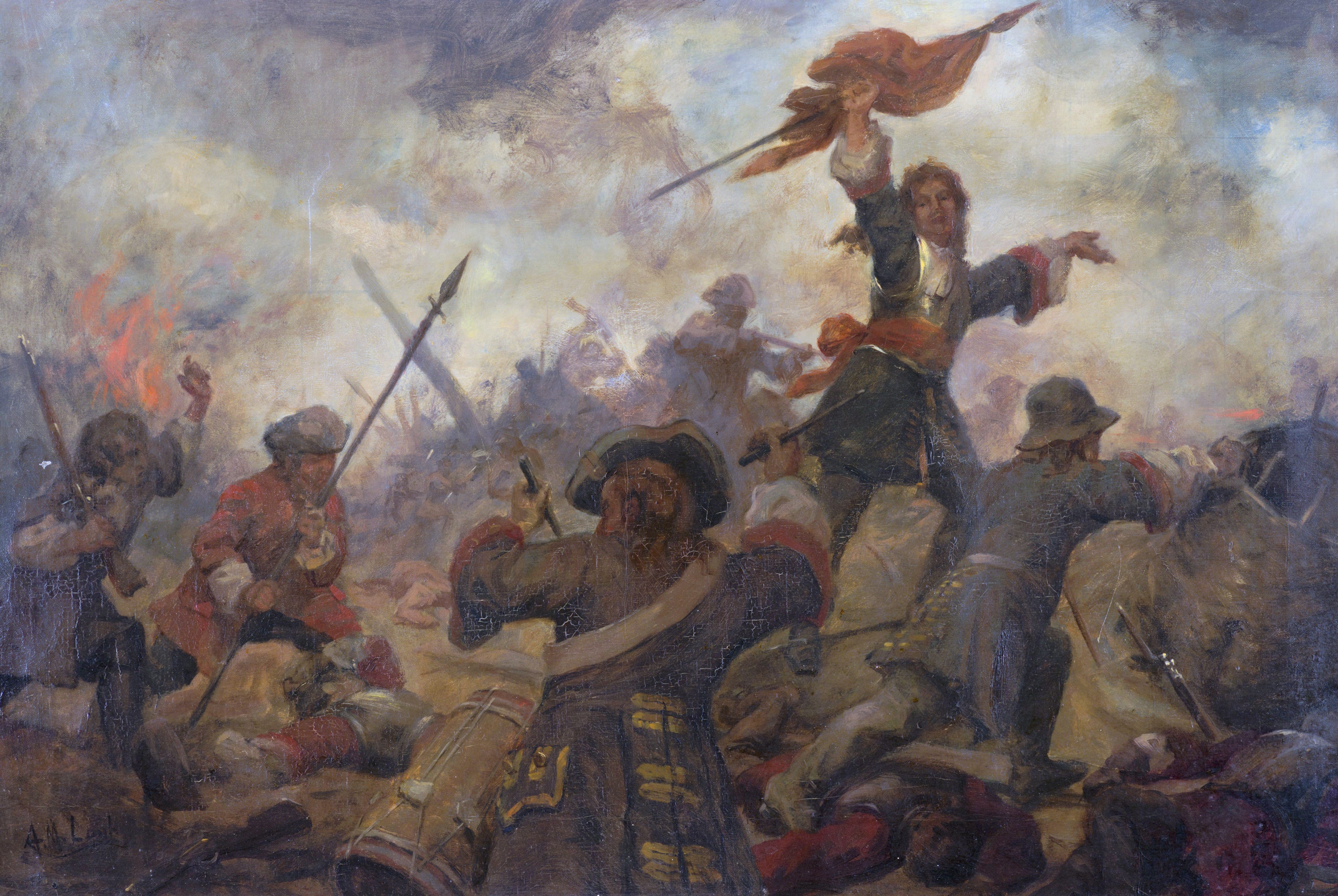
Boufflers chose not to launch a small tactical pursuit with his reserve cavalry. His orders from Villars had been clear: he was not to counterattack the enemy, even if they were driven before him. Besides, Orange’s own cavalry, under the command of the landgrave of Hesse-Kassel (and future king of Sweden), moved up to cover the shambolic route of the spent Dutchmen. The Chevalier de Bournays certainly believed that Boufflers would have swept the Dutch from the field entirely had he attacked, but respected his superior’s decision not to attack “in consideration of Maréchal Villars.” It is possible that Boufflers also feared that this attack was a feint. Marlborough still had his reserve infantry and almost all his cavalry uncommitted. If Boufflers left his impressive fortifications, he would be extremely vulnerable to a massed Allied counterattack.
Orange was still not done: rearward, he began to reform his regiments once more for a third attack. The Dutch 20-gun battery on the left, close to the Lanières Wood, covered the troops as they reformed with steady salvos. Then Marlborough and Eugene rode over from the right to inspect Orange’s progress, having heard that the Dutch had been beaten back twice and suffered heavy losses. Finding the Allied left in complete tatters and combat-ineffective, Marlborough hurriedly found Orange and ordered that a third attack not be mounted. The two Allied commanders then went back westward to oversee the Imperial advance through the Sars Wood.
The fighting on the eastern end of the field thus died off, a crushing French success that had nevertheless left several of their regiments sorely spent and with heavy losses. It was only 10am; the Dutch attacks had not lasted more than 90 minutes. Yet there had been some profit for the Allies. With so much of Boufflers’ infantry engaged in holding the entrenchments, his reserve battalions could not be peeled off and sent west to fight against Schulenburg and Lottum. For decades, since the 1680s, the Dutch infantry had been heralded as probably Europe’s best in discipline, training, and morale. This, the spectacularly bloody failure to overrun the French right at Malplaquet, was nevertheless probably their finest hour.
Jaws of hell, pit of fire: Villars counterattacks at the Sars Wood
By 11am the Dutch were in the process of reforming, and d’Albergotti’s troops had been pushed entirely out of the Sars Wood and into the entrenchments occupied by the Marquis de Puységur’s men on the far left, in front of the village of La Chaussée du Bois. Eugene’s infantry had been successful in driving the French from one end of the wood to the other, but the price had been fearful. Of about 30,000 Allied infantry committed to these attacks on the western end of the battlefield, probably about 7000 were casualties before noon. Already, this was the bloodiest of Marlborough’s battles, and it was far from over.
On Puységur’s flanks, toward the rear, were two small divisions of cavalry. D’Albergotti’s troops were disorganized from the chaotic fighting in the poor terrain of the Sars Wood, but Puységur’s infantry were well-sited to provide resistance to the Allied advance. The Imperial attack, should it come, would eventually overwhelm them by sheer numbers alone, though. The Sars Wood had become a complete mess of musketry and bayonet attacks in impossible terrain. It was “a sort of jaws of hell,” Villars later wrote in his report to the king, “a pit of fire, sulfur, and saltpeter, which it seemed impossible to approach and live.” Nevertheless, he recognized this moment as probably the crisis of the battle, and he rushed there on horseback to take command personally.
On the way, he ordered the battalions of the Irish Brigade to abandon their redans between the 5- and 10-gun batteries in the center, and to move northwest and attack Schulenburg’s and Lottum’s disorganized mass of troops at the southern edge of the wood. These expatriates marched northwestward and attacked at the treeline; one French Irish battalion actually engaged Sir Henry Ingoldsby’s Royal Irish battalion, the former firing by rank and the latter by platoon, each inflicting great loss on the other until the French-serving Irish, unable to make any headway, retired in good order.
Around this time Eugene returned from speaking with Orange (Marlborough having returned to his headquarters in the center), and he attempted to aid Schulenburg in reforming his hopelessly disorganized battalions prior to the next attack against Puységur. Around this time the Italian prince was lightly wounded by a musketball grazing his ear, drawing blood, but despite the pleas of his staff, he refused to go to the rear. Villars called on more battalions to supplement the Irish in a second push, these being Bavarians and assorted other German expatriate regiments from the center. Again they attacked northward, into the southeastern corner of the Sars Wood. Again, they were repulsed with heavy loss. Partly because of these piecemeal but bloody attacks, and partly because of Schulenburg’s own realization that his men were exhausted from the initial assault against d’Albergotti into and through the Sars Wood, the Allies realized that they did not have the strength necessary to attack and overrun Puységur. Meanwhile, d’Albergotti had managed to reform most of his battalions to the rear.
Villars thus had on the left 50 battalions between Puységur, the survivors of d’Albergotti’s command, and the Irish and German regiments pulled from the center; probably about 18 or 20,000 men in all. Villars, riding close to the front, ordered the advance back into the Sars Wood, to the cheers of the soldiers around him. In a matter of moments the French were near the treeline. Then General St. Hilaire, commanding the last few battalions in the center, arrived and, in an uneasy voice, informed Villars that the earthworks formerly held by the Irish Brigade had been seized by Allied infantry!
Suddenly, the clatter of musketry began to fill everyone’s ears. A bullet hit Villars’ horse and he fell from the saddle. Another bullet struck the marshal-duke in the knee, crippling him. D’Albergotti and Chémerault, accompanying Villars in his advance, jumped from their horses and shielded Villars with their bodies. Both were hit; Chémerault was killed. Villars recalled:
One shot and my horse fell. I jumped up and a second broke my knee. I had it bandaged on the spot and myself placed in a chair [litter] to continue giving orders. But the pain caused a fainting fit, which lasted long enough for me to be carried off without regaining consciousness. That is all I know about the end of the battle.
Their charismatic leader now wounded and possibly dying, the French army became effectively leaderless in what was already becoming the bloodiest battle of the war (though Boufflers took command, by seniority, once he learned what had happened). It was about 1 o’clock.
The first rank of the French line saw Villars go down and carried from the field. Rumor quickly spread that he was killed. With Chémerault and d’Albergotti now hors de combat, the entire French left fell by rank under the command of Puységur, who, way out on the extreme left, was unable to coordinate Villars’ planned attack. The momentum and opportunity for a French advance quickly faded away. Despite the sudden headless snake it had become, the French infantry did not break and flee, but withdrew a few hundred paces in good order, outside of musket range, while Puységur attempted to restore order over the whole French left.
Villars had been mistaken. The issue in the Sars Wood was not the crisis of the day. The most dramatic and decisive act of the battle had yet to unfold. It began mere minutes before Villars was wounded and carried from the field.
A great slaughter: The cavalry melee
Even as Villars was organizing his 50 battalions at the Sars Wood, Marlborough, from his central headquarters, noticed sometime shortly after 12 o’clock that Villars had begun emptying his redoubts on his center-left. He ordered the Earl of Orkney to send his reserve infantry in the center forward, to seize the lightly (if that)-held earthworks and finally break the French line in two. The Allied reserve cavalry, under d’Auvergne, Wood, Bülow, and Württemberg were to mount a general advance in support of the infantry.
At around 1:30pm, Boufflers learned that Villars had been wounded and that the army was now his responsibility. By this time, Orkney’s infantry were breaching the French line where formerly the Irish and German regiments had stood. In fact, St. Hilaire was correct when he had warned Villars that these redans had already been taken by 1 o’clock. Now the Allied cavalry were moving up in support, passing through the freshly-captured entrenchments and forming up on the plain beyond. Marlborough and Eugene were with them, overseeing this splendid advance and bloodless success. The French and Swiss Guards regiments, the only infantry at hand to repel the assaults, astonishingly gave way after firing just a single long-range volley; nearby French officers noted this with disgust, especially after having witnessed the bravery exhibited and carnage endured by the French infantry under d’Albergotti and d’Artagnan. The battle would then be decided by the French cavalry—“the arm of decision,” according to Napoleon—led in person by the 65 year-old Boufflers. The Allied cavalry numbered probably 30,000; Boufflers concentrated almost all the French cavalry, at least 24,000 and possibly up to 27,000, opposite them; and then the French, seeking to retake the earthworks, attacked, with generals de Magnac and Coigny leading the way, and Boufflers not far behind.
Winston Churchill, in his own histories of his ancestor Marlborough, wrote that this was “one of the greatest cavalry actions of history.” Proud or self-serving glorification aside, he was right. There is good argument to be made that it was possibly the largest cavalry battle in history. It has often been forgotten in popular histories and summaries of the battle. Present were not only Marlborough, Eugene, the aged Boufflers, and the Duke of Württemberg, but even the Jacobite pretender to the English throne, 21 year-old James Francis Edward Stuart, was deep in the melee, serving with the elite French household cavalry (Maison du Roi). At one point, the Scots Greys regiment, famous for their desperate charge at Waterloo 106 years later, charged the Maison du Roi and put them to flight for a few moments. Repeated charges by one or two dozen squadrons across the field continued for over an hour as the French fought desperately to drive the Allies back across the open field toward Aulnois, while the Allies clung on stubbornly in defense of their lodgment in the French line. The French cavalry, revered before the war for their quality but recently besmirched for inferior conduct at various battles, restored in large part their reputation as being well-trained, well-disciplined, and hard-fighting. Cavalrymen would charge forward with carbines and two pistols, one in each hand, with other pistols slung over their shoulders and on their bandoliers, firing at point-blank range; then draw their sabers when their ammunition ran out. An Irishman in the French cavalry recalled:
The squadron that I belonged to was commanded by the Chevalier de Janson […] who ordered that six men on the right and six men on the left of his squadron should, on the signal given by him, detach themselves and fall on the flanks of the squadron we should engage, and pour in their carbine shot among them, whilst he would, with he remainder of the squadron sword in hand, endeavour to break through the enemy. […] by this stratagem we broke through them and through a second [squadron] by the like method […] We marched on to engage a third squadron, which broke in seeming confusion, or rather opened right and left on purpose to draw us under the fire of Colonel Pendergast’s [British infantry] regiment, who lay unseen by us at the reverse of the entrenchment and poured their shot among us, and some other French squadrons that had penetrated so far, which made a great slaughter.
Others also wrote that the French cavalry at places broke through to the entrenchment line, only to be thrown back by the British infantry who had to that point been watching the fight unfold. “I really believe,” later wrote Orkney, “had not the foot [infantry] been there, they would have driven our horse from the field.”
A second smaller cavalry action developed on the far left, when a detached part of Württemberg’s cavalry, under the command of General Miklau, rounded the Sars Wood and came down on the rear of the entrenched French infantry under Puységur. There they were met by the last uncommitted French cavalry, which included several squadrons of the Spanish Guard and ten squadrons of the elite French Carabiniers. The Carabiniers’ commander, Chevalier de Rozel, reported: “Almost all the officers of the enemy’s [Miklau’s] right were killed or captured. One has never seen such carnage in a cavalry action. We followed them into the woods and took from them their standards.” A few days before the battle, Rozel’s troopers had been embarrassed and badly handled in a skirmish with Imperial hussars. Now, no quarter was given.
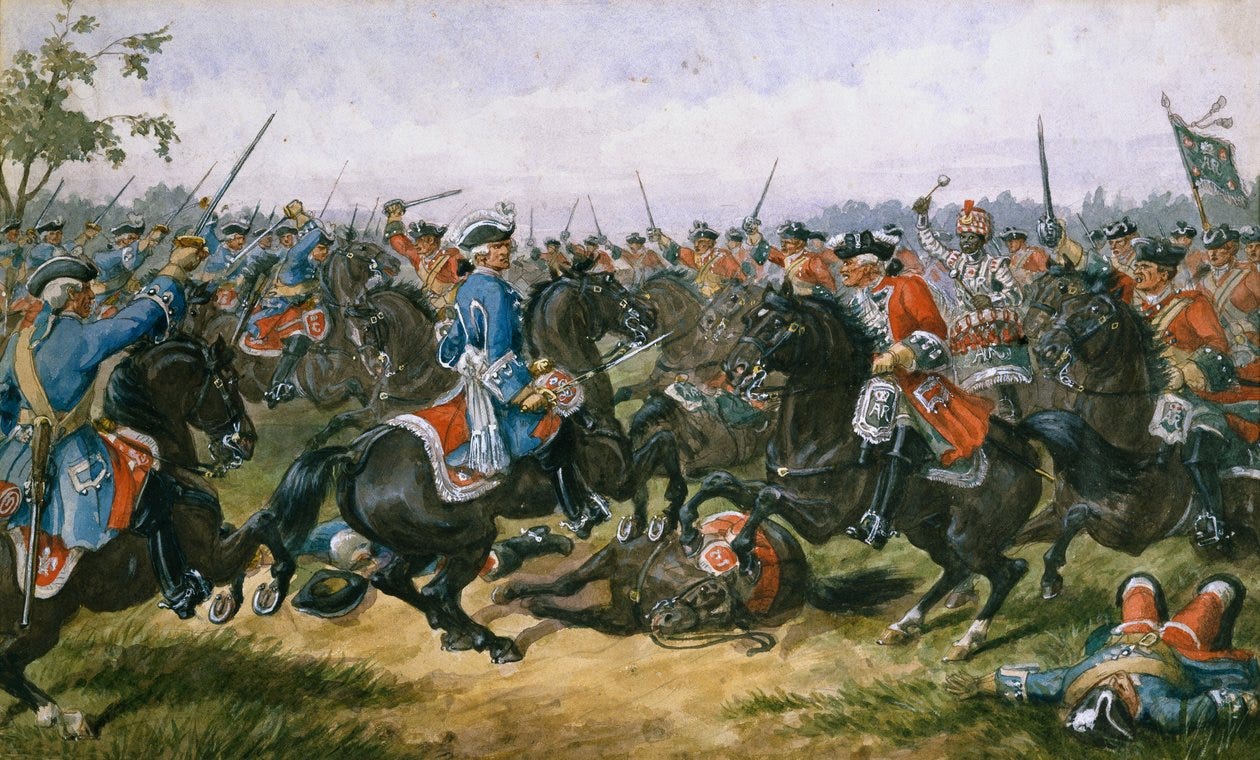
Schulenburg decided not to attack with his exhausted infantry out of the woods, fearing the impressive array of reorganized French infantry opposing him under Puységur. Miklau was thrown back, thus saving the French left from disaster.
Debouchement and denouement: Boufflers cedes the field
The cavalry action in the center swirled chaotically and violently for over an hour, with thousands of troopers charging, reeling, reforming, and countercharging over and over. Puységur, however, could see that the repeated French charges were making no headway in restoring the original French line. He also grew increasingly worried about the Allied infantry in the Sars Wood, whom he knew greatly outnumbered Puységur’s command. Schulenburg, for his part, later claimed that he was in no position to attack, even with the aid of Lottum, whose troops were just as disorganized and stricken by casualties as his own.
Boufflers finally retired from the cavalry action, miraculously still alive, and took stock of his situation. Puységur remained unengaged but heavily outnumbered; the cavalry attack in the center had thus far not succeeded; and d’Artagnan, on the right, also grew increasingly worried. The Dutch in his front had finally finished reforming and might be coming on again; and if the Allied cavalry won control of the center of the field, he would be at risk of being completely destroyed. Then news reached Boufflers that Orange, astonishingly, was coming forward once more, for a third time, with both the remnants of his infantry and the full body of his unengaged cavalry. Even if this attack could be repulsed as handily as the first two, it would have no effect on the outcome of the battle if the French cavalry were defeated. In fact, it may even keep d’Artagnan pinned to his works so long that they would be destroyed in isolation from the rear. Boufflers therefore felt he had no choice in the matter. At 3pm, he gave the order for the army to retreat. As French artillerists began to carry away their guns, the cavalry answered the bugle-calls to withdraw, and the infantry moved away in good order; the Allies, battered with severe exhaustion and heavy casualties, could not pursue.
Marlborough wrote toward the end of the day, “The French have defended themselves better in this action then [sic] in any battle I have seen.” Villars’ words also brimmed with pride at the conduct of his troops: “Your Majesty’s troops,” he wrote to Louis after the battle, “have done marvels. Although your army is in retreat, it will become clear that it has lost less men than the enemy.” It is the general’s wont to obfuscate and to undersell his own losses while overselling the enemy’s. But in this instance, at Malplaquet, Villars was right. Though he had been defeated and forfeited the field, the battle had been a slaughter of the Allies, not the French.
As is typical after a great battle, both sides were hopeful for further success; the French, that the battle had actually been a bloody victory; the Allies, that France was now no longer able to carry on the war. Marlborough, in his post-battle letters, hoped that, despite “a very bloody battle […] it is now in our power to have what peace we please, and I may be pretty well assured of never being in another battle.” In his second assumption he was correct: Marlborough never commanded in battle again. But peace in the war was far from at hand, and the peace eventually agreed to in 1714 was far from that which Marlborough believed he had won on the French frontier in September 1709.
The French cavalry disengaged quickly and d’Artagnan supervised the withdrawal of all forces on the French right, including most of the army’s artillery. Ultimately, 66 guns were recovered and taken from the field; only 14 were given over to the Allies, which, in an era where these pieces were often too heavy to move quickly if an army had to withdraw, is a remarkable achievement. It is a testament not only to the cohesion and morale of the battered French troops, but also to the utter exhaustion of Allied forces that they chose not to hound the French in their retreat.
Even more remarkable was the sanguinary nature of the battle and its results. Having brought about 90,000 men to the field, the French left it with over 70,000 still in fighting condition, if exhausted. Casualty estimates for both armies, as for the armies’ strengths, are imperfect, but Villars and Boufflers probably lost about 12,000 men killed, wounded, and captured. (One French participant estimated shortly after the battle that Villars had lost 17,000 men. The lower end of modern estimates claim about 10,000.) Marlborough and Eugene were stopped cold by the reports of their losses: between 21- and 25,000 killed and wounded, shocking numbers for the day, and a far cry from the comparatively bloodless victories of Blenheim, Ramillies, and Oudenarde. Also remarkable was that the French, even in defeat, surrendered only 500 men as prisoners over the entire battle and its immediate aftermath.
The French retreat was, in fact, its own very impressive feat of arms, just as much as any incident of bravery and ability displayed by the army in the battle itself. Boufflers wrote on September 16, upon reviewing the army, “It is more beautiful and proud than before the battle.” The army was in no shape to fight, however. It remained hungry with intermittent shipments of food, and the artillery had expended nearly all of its ammunition stocks. As battered as the Allied army was, to invite battle with it again was to court disaster and annihilation. The Allies knew this; they drew off toward Mons and, still capable of conducting siege operations, invested it on September 19 and compelled its surrender on October 20.
Villars, badly wounded in the knee, escaped the immediate fears of amputation by telling his grenadier escort to shoot any doctor who attempted the operation. In the days after the battle his health worsened, and he requested and received extreme unction (a part of last rites), while his wife came out from Paris to see him in camp. After another surgeon examined Villars’ wound, extracted the ball, and bandaged it, Villars’ health began to return. The king made him a Peer of France, and he remained with the army in the field, but Boufflers, still in good health, was to take command so long as Villars was incapacitated.
The battered Army of Flanders withdrew further into France and already began settling into winter quarters. By the times Mons fell, the weather had begun to turn. It was by this point evident to the Allies that Malplaquet was not the knockout blow they had hoped for. In fact, it was an entirely profitless victory. While the French had lost the battlefield, the British were to lose their will to fight, and the Allies their best and most successful commander. Painted as a butcher in the British press and by his numerous political opponents, it led rather directly to Marlborough’s political downfall and the end of his military career, though he would remain in command for another two uneventful years. Eugene’s star remained undimmed, and Villars became, even in defeat, the hero of France.
Malplaquet was not only militarily and diplomatically important, but also represented the beginning of a radical shift in the way battles were fought. As previously noted, the deployment of artillery by both armies was novel. MacDowall writes that,
The grand 40-gun battery that supported Lottum’s attack, and the enfilading 20 French guns that decimated the Dutch, were both crucial to the success of their respective wings. Such artillery tactics became the norm in later years, but in 1709 they were quite revolutionary.
For a time, too, Malplaquet signaled a reversal in the declining battlefield importance of cavalry. The final dramatic action of the battle was one of the largest cavalry engagements in history, in which both sides acquitted themselves well, and from which the defeated French withdrew in good order. By the middle of the century, the innovation of the famed infantry square would once again badly hamper the usefulness of cavalry in battle, but the cavalry arm would see one final and glorious resurgence during the height of the Napoleonic Wars.
Whether Marlborough and Eugene actually planned to draw French troops away from the center, or if their main effort really was on the flanks, remains debated. It is the author’s opinion that the Allied commanders, in the evening and early morning before the battle, did not actually intend on ever attacking the French center. Villars’ field works were too strong, and Orkney’s troops were too few in number to actually charge and capture the defenses even if French forces there were stripped away to a skeleton crew. If even a dozen French battalions had been present, Orkney’s losses would have been severe. Orkney’s troops were a prudently-held reserve, and probably not actually meant to advance down the center. The deployment of Allied infantry on the flanks was so significant as to indicate that they very likely hoped to employ a double envelopment, rather than Marlborough’s heretofore favored tactic of weakening and then striking the center. As events played out, however, the flanks proved too strong, and Allied numbers, plus Marlborough’s continued maintenance of the tactical initiative, told the story from there.
How the battle would have proceeded had Villars not been severely wounded is difficult to say. He was warned mere moments before he was shot that the British infantry had taken the redoubts in the center. Would he have called off the attack on the left, and sent some of his infantry back east to retake the works, supported by the reserve cavalry? As Orkney said, if the British infantry had not been present, there was a serious risk that the French cavalry could have retaken the entrenchments. If French infantry had been present, they could have been maneuvered into Orkney’s flank, or at least provided additional firepower in support of the attack by the French horse.
Malplaquet was one of the last major battles in which virtually every senior commander led from the front for at least a portion of the action. This behavior, while emotionally stirring, narratively exciting, and carrying the potential to sway the morale of troops on both sides, also abrogates the commander’s primary and only responsibility: to command. It is nothing short of a miracle that Eugene and Orange were not seriously wounded or killed. By extension, Villars came very close to death, and his needless, if emotionally powerful, presence leading the French infantry on the left deprived him of the ability to issue orders to other commanders on the field, or to receive timely updates on the progress of the battle elsewhere. It also led to the severe wounding of the Comte d’Albergotti and the death of the Comte de Chémerault, leaving the entire left wing of the French army in chaos, and inserting needless and potentially fatal command paralysis at the height of the battle. Similarly, Boufflers’ presence in the cavalry melee at the end of the battle meant that he could not issue orders to Puységur nor to d’Artagnan, the last senior-ranking French commanders on the field.
Lynn outright calls Malplaquet a Pyrrhic victory for the Allies. “Malplaquet did not save Mons,” he says, “but it may have saved France.” Villars, as mentioned earlier in his report to King Louis, agreed. The battle significantly weakened the Grand Alliance, diplomatically if not militarily; restored French faith in its armies and its leaders; and propelled to the top of the army her last best general, whose future successes, particularly a stunning victory over Eugene at Denain in 1712, would fully reverse France’s unfavorable position in the war, and secure a status quo ante bellum in the treaties of 1714. Charles II’s chosen successor, the Bourbon Philippe, was confirmed by treaty as King Philip V of Spain. In this sense the war was a failure for the Grand Alliance: the Bourbons were not kept from ascending to power in Madrid. With some interludes, most notably from 1931 to 1975, they remain on the Spanish throne today; the king, as of 2026, is Philip (Felipe) VI.
French dominion over Iberia, however, would escape Louis’ grasp, and the Sun King died barely a year after the war ended. Louis would not be the last French monarch to attempt to assume control of Spain, and future endeavors would also be complicated and spoiled by Britain, whose concern over French continental dominion animated its foreign policy for centuries.
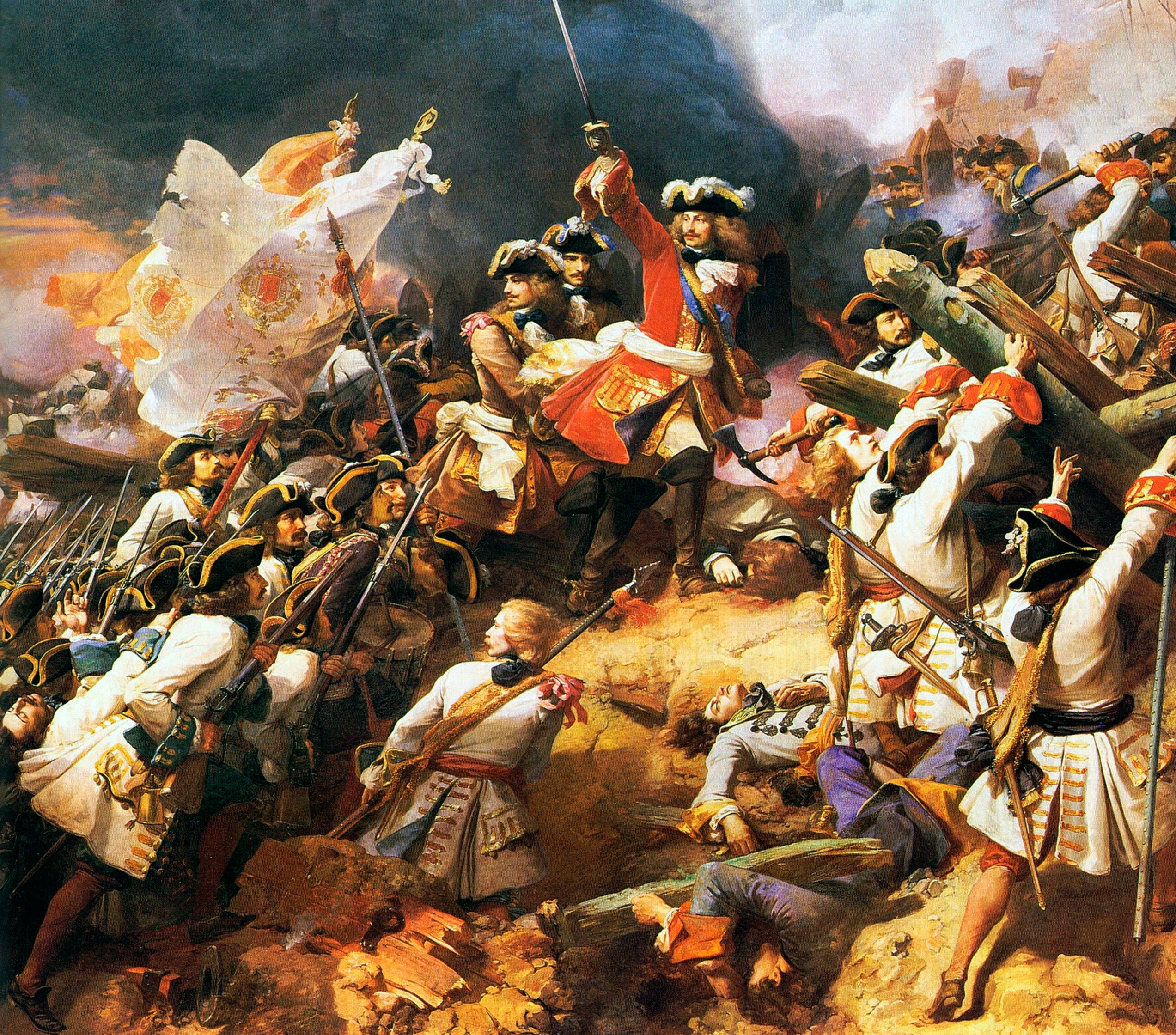
Marlborough made significant further contributions to the war effort, including an impressive and bloodless campaign in 1711 wherein he turned Villars out of his strong fortifications without a battle and returned Allied forces to the French frontier. However, having already lost Queen Anne’s favor, and with the ascendance of the hostile Tories in Parliament, he was sidelined and then dismissed on charges of corruption. He entered exile in the Netherlands, but was returned to favor by King George I after the death of Anne in 1714. Like his partner and friend Eugene and opponent Villars, he is still considered one of the greatest generals in history. He died in 1722 aged 72.
Villars was out-generaled by Marlborough in 1711, but he prevented a second invasion of France and kept his army intact. When Britain recalled its troops from the Continent in 1712, Villars struck and won a major victory over Eugene at Denain. After Louis’ death, Villars became one of the most powerful figures in Versailles court politics. In 1733, he was made Marshal General of France,17 essentially supreme commander of the French army, and died the following year at 81 years old.
Eugene, despite his ignominious defeat at Villars’ hands at Denain in 1712, continued to command significant respect as one of Europe’s finest generals. His last victory was against the Ottoman Turks at Petrovaradin in 1716, where a series of massed cavalry counterattacks routed the much larger Ottoman army and inflicted heavy casualties. He then became minister of war, and assumed command of all Imperial forces in the War of the Polish Succession in the 1730s, but his physical and even mental health had declined precipitously, and his contribution was limited. He retired before the end of the war, and died in 1736 at the age of 72.
“The Wars of Louis XIV, 1667–1714” by John A. Lynn
“The Art of Warfare in the Age of Marlborough” by David Chandler
“Marlborough as Military Commander” by David Chandler
“On War” by Carl von Clausewitz
“The War of the Spanish Succession” by Ludmila Ivonina
“Malplaquet 1709: Marlborough’s Bloodiest Battle” by Simon MacDowall
“Parallel Lives: Pyrrhus” by Plutarch
“Marshal Villars and the War of the Spanish Succession” by Claude C. Sturgill
Marlborough was born into what was essentially the English 17th century middle class. That he became a duke by merit, like Wellington a century later, is a testament to his ability and, more importantly, his self-confidence and perseverance.
In 1704, he campaigned in southern Germany.
Later, the Austrian army suffered a heavy defeat in 1859 against France in a struggle for control of northern Italy. The lesson they took from the war was fatal: a shift, once again, to a doctrinal preference for shock over fire. The results in the 1866 Austro-Prussian War, wherein the Prussians were armed with fast-firing breech-loading rifles and accurate quick-firing Krupp artillery, were disastrous.
Accounting for light losses due to disease, desertion, and casualties. The campaign strength for a Napoleonic cavalry squadron was generally around 110 or 120 men, though was sometimes higher depending on the army and circumstances.
Many generals of the age would unthinkingly put themselves in danger during battle, not just out of a sense of honor, but also of duty—because they felt it was simply what must be done. They all very well understood the lethal stakes involved: Turenne, one of the great generals of the 17th century, was disemboweled by a cannonball in his final battle.
Marlborough also served under Turenne during the latter’s famous final campaign as part of a minor English expedition to support its temporary French ally.
One of the men whom he singled out for promotion was Maurice de Saxe, the ethnically German bastard son of King Augustus II of Poland. Saxe later led French armies to myriad successes in the War of the Austrian Succession (1740–48). In an amusing turn of events, Saxe also served under Eugene during the Austro-Turkish War of 1716–18. Saxe, an engineer, would later take a page from Villars’ book and employ earthen redoubts to great success at his most famous battle, Fontenoy, in 1745.
In the 17th and 18th centuries, both in France and elsewhere in Europe, the rank of marshal was generally the only rank entitled to, or capable of, commanding an independent army in the field.
Aside from Marlborough’s victories at Blenheim, Ramillies, and Oudenarde, Voltaire also counted the Battle of Schellenberg, a smaller but decisive battle prior to Blenheim, and Prince Eugene’s breaking of the French siege lines at Turin in 1706 which ended the war in Italy.
For his skilled conduct, as was the tradition at the time, Bouffleurs was released from captivity and sent back to France. In premodern warfare, this was considered a gentlemanly thing to do, as it was a sign to the defeated sovereign that “this general fought with honor and defended the colors” (which were the property of the monarch; to lose them was to disgrace him). Bouffleurs escaped punishment, and then was put in command of the Army of Flanders.
Tilly was the grandson of the same-titled Johann Tserclaes, Count of Tilly, who was the most famous and successful of the Imperial generals during the Thirty Years’ War.
Lynn estimates the Allies’ strength at “about 100,000” at the beginning of the campaign, and reduced by the time of Malplaquet to 86,000; compared with Villars’ force of “probably […] 75,000.” These are on the lower end of scholarly estimates. Chandler estimates the Allied army at 110,000, with Ivonina agreeing and, citing Delbrück, estimating an even higher 95,000 for Villars. The slightly lower figures given in the main text, which also seem more reasonable than the minimalist numbers from Lynn, are derived at least partly from MacDowall’s calculations, as well as my own.
“Corps” in this case is meant in the literal manner, i.e a general, nondescript “body” (from the French) of troops, rather than the Napoleonic-era innovation of a separate echelon of the command hierarchy.
The French deployment echoes the English deployment at Agincourt in 1415. It is possible that battle provided some inspiration to Villars, and like most generals of the age Villars was well-educated in military history, but there is no evidence suggesting or refuting it.
At the Battle of Entzheim in 1674, while serving under Turenne, Marlborough, then simply the 24 year-old John Churchill, participated in the attack which drove enemy forces out of the wood on the Imperial left.
In principle, in 17th–19th century infantry combat, it was best to hold your “first fire” as long as possible. If the enemy fired first, you would have a short span of time in which you could continue to advance and then fire at an even closer distance, before the enemy could reload.
Villars was the last person appointed to this position during the Bourbon monarchy. The last Marshal General of France was Jean-de-Dieu Soult, one of Napoleon’s marshals, who was appointed to the role in 1847 by the Orleanist King Louis-Philippe at the age of 78.